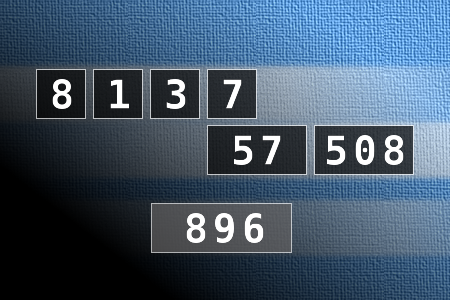
Calculate the number 896
[3025] Calculate the number 896 - NUMBERMANIA: Calculate the number 896 using numbers [8, 1, 3, 7, 57, 508] and basic arithmetic operations (+, -, *, /). Each of the numbers can be used only once. - #brainteasers #math #numbermania - Correct Answers: 43 - The first user who solved this task is Djordje Timotijevic
BRAIN TEASERS
enter your answer and press button OK

Calculate the number 896

NUMBERMANIA: Calculate the number 896 using numbers [8, 1, 3, 7, 57, 508] and basic arithmetic operations (+, -, *, /). Each of the numbers can be used only once.
Correct answers: 43
The first user who solved this task is Djordje Timotijevic.
#brainteasers #math #numbermania
Register with your Google Account and start collecting points.
Check your ranking on list.

Harry under stress

Harry had been feeling sick lately and was finally convinced to see the Doctor after his wife Suzy's urging.
After a thorough examination, and much thought, the Doctor was ready to tell Harry and a very worried Suzy, his prognosis: Harry was too stressed out. He would need 6 months of pure relaxation.
Suzy, very agitated, took out her notepad to begin writing down his list of orders for these months of relaxation.
"How should I go about it?" asked Harry.
"OK," said the doctor, "I would like your wife to take one tranquilizer four times a day..."
Jokes of the day - Daily updated jokes. New jokes every day.
Follow Brain Teasers on social networks

Brain Teasers

puzzles, riddles, mathematical problems, mastermind, cinemania...

Electron

In 1897, at the Royal Institution Friday Evening Discourse, Joseph John Thomson (1856-1940) first announced the existence of electrons (as they are now named). Thomson told his audience that earlier in the year, he had made a surprising discovery. He had found a particle of matter a thousand times smaller than the atom. He called it a corpuscle, meaning "small body." Although Thomson was director of the Cavendish Laboratory at the University of Cambridge, and one of the most respected scientists in Great Britain, the scientists present found the news hard to believe. They thought the atom was the smallest and indivisible part of matter that could exist. Nevertheless, the electron was the first elementary particle to be discovered.
This site uses cookies to store information on your computer. Some are essential to help the site properly. Others give us insight into how the site is used and help us to optimize the user experience. See our privacy policy.