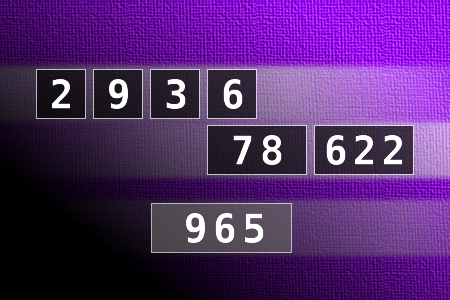
Calculate the number 965
[5795] Calculate the number 965 - NUMBERMANIA: Calculate the number 965 using numbers [2, 9, 3, 6, 78, 622] and basic arithmetic operations (+, -, *, /). Each of the numbers can be used only once. - #brainteasers #math #numbermania - Correct Answers: 27 - The first user who solved this task is Fazil Hashim
BRAIN TEASERS
enter your answer and press button OK

Calculate the number 965

NUMBERMANIA: Calculate the number 965 using numbers [2, 9, 3, 6, 78, 622] and basic arithmetic operations (+, -, *, /). Each of the numbers can be used only once.
Correct answers: 27
The first user who solved this task is Fazil Hashim.
#brainteasers #math #numbermania
Register with your Google Account and start collecting points.
Check your ranking on list.

Eddie in Dallas calls his son...

Eddie in Dallas calls his son in New York just before Thanksgiving and tells him, "I'm sorry to tell you but your mother and I are getting a divorce. I just cannot tolerate any more of her constant complaining. We can't stand the sight of each other any more. I'm telling you first, Jerry, because you're the oldest. Please tell your sister."
When Jerry calls his sister Julie in Miami, she says: "No way are they getting divorced. I'll go there for Thanksgiving and talk them out of it."
Julie phones here father and tells him: "You must not get divorced. Promise me you won't do anything until I get over there. I'm calling Jerry and we'll both be there with you tomorrow. Until then, don't take any action. Please listen to me." Then she hangs up.
The father puts down the phone, turns to his wife Frances and says, "Good news! Jerry and Julie are coming for Thanksgiving, and they're both paying their own way."
Jokes of the day - Daily updated jokes. New jokes every day.
Follow Brain Teasers on social networks

Brain Teasers

puzzles, riddles, mathematical problems, mastermind, cinemania...

Brook Taylor

Died 29 Dec 1731 at age 46 (born 18 Aug 1685).British mathematician, best known for the Taylor's series, a method for expanding functions into infinite series. In 1708, Taylor produced a solution to the problem of the centre of oscillation. His Methodus incrementorum directa et inversa (“Direct and Indirect Methods of Incrementation,” 1715) introduced what is now called the calculus of finite differences. Using this, he was the first to express mathematically the movement of a vibrating string on the basis of mechanical principles. Methodus also contained Taylor's theorem, later recognized (1772) by Joseph Lagrange as the basis of differential calculus. A gifted artist, Taylor also wrote on basic principles of perspective (1715) containing the first general treatment of the principle of vanishing points.«
This site uses cookies to store information on your computer. Some are essential to help the site properly. Others give us insight into how the site is used and help us to optimize the user experience. See our privacy policy.