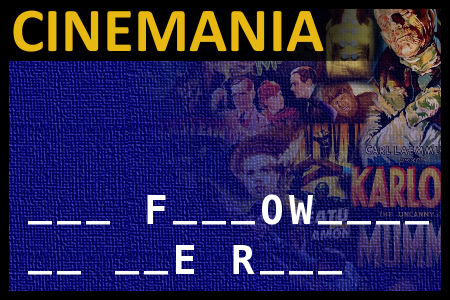
CINEMANIA: Guess the movie title
[1311] CINEMANIA: Guess the movie title - Film was made in 2001. - #brainteasers #movie #film #cinemania - Correct Answers: 42 - The first user who solved this task is Allen Douglas
BRAIN TEASERS
enter your answer and press button OK

CINEMANIA: Guess the movie title

Film was made in 2001.
Correct answers: 42
The first user who solved this task is Allen Douglas.
#brainteasers #movie #film #cinemania
Register with your Google Account and start collecting points.
Check your ranking on list.

Honey, What Did the Doctor Say?

A middle aged man goes into the doctor's office for a check-up with a litany of complaints. The doctor speaks to the man’s wife alone and says, "There is nothing the matter with your husband. If you make a couple of meals for him a day, let him watch his sports. Do not complain at him too much and require him to listen. Limit his exposure to in-laws and make love to him once a week. Then, he’ll probably live another 20 years."She returns to her husband’s side in the waiting room. He asks,
"What did the doctor tell you?"
"You are going to be dying soon, my dear."
Jokes of the day - Daily updated jokes. New jokes every day.
Follow Brain Teasers on social networks

Brain Teasers

puzzles, riddles, mathematical problems, mastermind, cinemania...

H. W. Bates

Born 8 Feb 1825; died 16 Feb 1892 at age 67. Henry Walter Bates was an English naturalist and explorer whose demonstration of the operation of natural selection in animal mimicry (the imitation by a species of other life forms or inanimate objects), published in 1861, gave firm support to Charles Darwin's theory of evolution. He and Alfred Russel Wallace left England in 1842 to explore and collect insects in the Amazon basin. Bates spent 11 years in Amazonia amassing large collections of insects that were sent back to museums and collectors in Europe. Bates was quick to embrace Darwin's and Wallace's theory of evolution by natural selection. Bates' own theory of mimicry, which now bears his name (Batesian mimicry), provided evidence for evolution by natural selection.
This site uses cookies to store information on your computer. Some are essential to help the site properly. Others give us insight into how the site is used and help us to optimize the user experience. See our privacy policy.