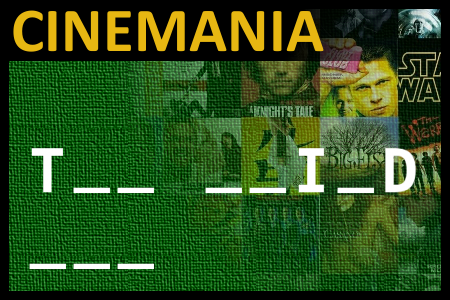
CINEMANIA: Guess the movie title
[1556] CINEMANIA: Guess the movie title - Film was made in 1949. - #brainteasers #movie #film #cinemania - Correct Answers: 46 - The first user who solved this task is Djordje Timotijevic
BRAIN TEASERS
enter your answer and press button OK

CINEMANIA: Guess the movie title

Film was made in 1949.
Correct answers: 46
The first user who solved this task is Djordje Timotijevic.
#brainteasers #movie #film #cinemania
Register with your Google Account and start collecting points.
Check your ranking on list.

3 spies are captured and imprisoned...

An american, a russian, and an italian.

The guards come for the american, bind his hands and drag him off. The other 2 hear his screams for sn hour, then nothing. In another hour the guards drag him back in, cut his bonds and dump him on a bunk. "All my training was for nothing, i told them everything."

They take the russian bind his ha ds and drag him out. And for 4 hours the others hear screaming, then nothing. In Another hour, the guards drag the russian back in, cut him loose crying. I yhought after a life in rusdia i had suffered the worst but it was nothing compared to what they did. I told them everything.

The guards then took the italian, bound him, and dragged him out. All day, and all night the others listen to his screams. After what seemed like forever the guards dragged the italian back in, cut him loose and dump him.

The russian says"you must be the toughest man on earth!"

The american says "how did you not break?"

The italian says, "i wanted to, i tried to tell them everything. But they wouldn't untie my hands!!!

Jokes of the day - Daily updated jokes. New jokes every day.
Follow Brain Teasers on social networks

Brain Teasers

puzzles, riddles, mathematical problems, mastermind, cinemania...

Sir Frank Macfarlane Burnet

Died 31 Aug 1985 at age 85 (born 3 Sep 1899). Sir Frank Macfarlane Burnet was an Australian physician, virologist, and recipient, with Sir Peter Medawar, of the 1960 Nobel Prize for Physiology or Medicine for the discovery of acquired immunological tolerance to tissue transplants. He studied the nature of antibody formation and immune processes and developed the notion of immunological tolerance to explain why humans do not form antibodies to their own bodily constituents. He also wrote about how mistakes of the immune system might cause obscure forms of blood, liver and kidney disease. He made pioneering use of fertile hen's eggs as hosts for virus multiplication. The concepts he developed are part of the basis for current theories about viruses as cancer-causing agents.
This site uses cookies to store information on your computer. Some are essential to help the site properly. Others give us insight into how the site is used and help us to optimize the user experience. See our privacy policy.