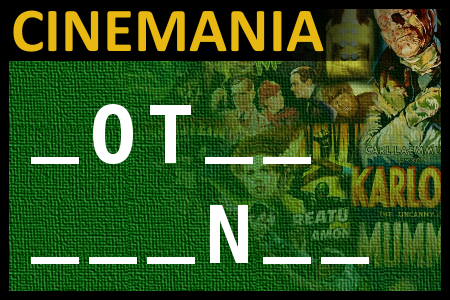
CINEMANIA: Guess the movie title
[650] CINEMANIA: Guess the movie title - The true story of Paul Rusesabagina, a hotel manager who housed over a thousand Tutsi refugees during their struggle against the Hutu militia in Rwanda. Film was made in 2004. - #brainteasers #movie #film #cinemania - Correct Answers: 61 - The first user who solved this task is Eric Newton
BRAIN TEASERS
enter your answer and press button OK

CINEMANIA: Guess the movie title

The true story of Paul Rusesabagina, a hotel manager who housed over a thousand Tutsi refugees during their struggle against the Hutu militia in Rwanda. Film was made in 2004.
Correct answers: 61
The first user who solved this task is Eric Newton.
#brainteasers #movie #film #cinemania
Register with your Google Account and start collecting points.
Check your ranking on list.

A little girl and a little boy...

A little girl and a little boy were at day-care one day. The girl approached the boy and said, "Hey Billy, want to play house?"
He said, "Sure! What do you want me to do?"
Sally replied, "I want you to communicate your feelings."
"Communicate my feelings?" said a bewildered Billy. "I have no idea what that means."
The little girl nods and says, "Perfect. You can be the husband".
Jokes of the day - Daily updated jokes. New jokes every day.
Follow Brain Teasers on social networks

Brain Teasers

puzzles, riddles, mathematical problems, mastermind, cinemania...

Sir C. Wyville Thomson

Born 5 Mar 1830; died 10 Mar 1882 at age 52.Sir C(harles) Wyville Thomson was a Scottish naturalist who was one of the first marine biologists to describe life in the ocean depths. He led the famous 110,224-km (68,890 mile) scientific expedition of HMS Challenger in (1872-6) which trawled the depths of the oceans for new forms of life. This was the world's first foray into big science. The Expedition was to circumnavigate the world in the steam corvette, HMS Challenger, with a goal, as resolved by the British Association (1871) of "carrying the physical and biological Exploration of the deep-sea into all the great oceanic centres". The extensive biological collections, together with soundings, bottom samples, and chemical and physical observations, presented the first broad view of the character of the oceans.
This site uses cookies to store information on your computer. Some are essential to help the site properly. Others give us insight into how the site is used and help us to optimize the user experience. See our privacy policy.