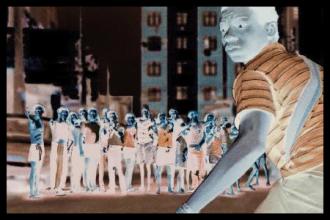
CINEMANIA: From which movie is this scene?
[707] CINEMANIA: From which movie is this scene? - CINEMANIA: From which movie is this scene? - #brainteasers #movie #film #cinemania #riddles - Correct Answers: 28 - The first user who solved this task is Sanja Šabović
BRAIN TEASERS
enter your answer and press button OK

CINEMANIA: From which movie is this scene?

CINEMANIA: From which movie is this scene?
Correct answers: 28
The first user who solved this task is Sanja Šabović.
#brainteasers #movie #film #cinemania #riddles
Register with your Google Account and start collecting points.
Check your ranking on list.

Animal Pictures

One day the teacher decides to play an animal game. She holds up a picture of a giraffe and asks if anyone knows what it is. No one raises his/her hand. The teacher says "See it's long neck? What animal has a long neck?"
Sally holds up her hand and asks if it is a giraffe.
"Very good Sally," the teacher replies. Next she holds up a picture of a zebra. None of the students holds up his/her hands. "See the stripes on this animal? What animal has stripes?"
Billy holds up his hand and says it is a zebra. "Very good Billy," the teacher replies. Next she holds up a picture of a deer. None of the students recognized the animal.
"See the big antlers on this animal. What animal has horns like this?"
Still no one guesses. "Let me give you another hint, it's something your mother calls your father."
Johnny shouts out "I know what it is, it's a horny bastard."

Jokes of the day - Daily updated jokes. New jokes every day.
Follow Brain Teasers on social networks

Brain Teasers

puzzles, riddles, mathematical problems, mastermind, cinemania...

Gordon Allport

Born 11 Nov 1897; died 9 Oct 1967 at age 69. Gordon Willard Allport was an American humanistic psychologist and educator who developed trait theory in an original theory of personality. Allport thought the uniqueness of each personality was one of the most important things to understand. Part of this uniqueness is due to the many, many parts of our personality. He and many other psychologists considered reflexes, habits, drives or needs, beliefs, our particular view of our environment, goals or intentions, values, attitudes, and traits as being the kind of factors that determine what we do. Thus, “personality” becomes very complex. Unlike Sigmund Freud, he did not see us as slavishly controlled by innate or external factors because humans have the ability to make conscious choices about how to behave.
This site uses cookies to store information on your computer. Some are essential to help the site properly. Others give us insight into how the site is used and help us to optimize the user experience. See our privacy policy.