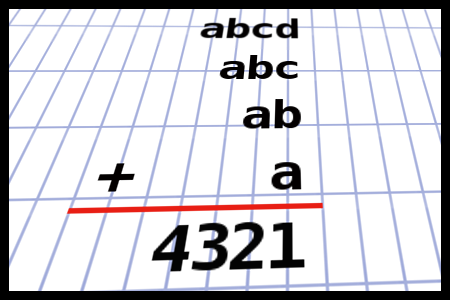
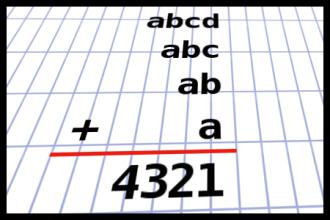
Determine the value of the number ABCD
[708] Determine the value of the number ABCD - Determine the value of the number ABCD - #brainteasers #math - Correct Answers: 58 - The first user who solved this task is Djordje Timotijevic
BRAIN TEASERS
enter your answer and press button OK

Determine the value of the number ABCD

Determine the value of the number ABCD
Correct answers: 58
The first user who solved this task is Djordje Timotijevic.
#brainteasers #math
Register with your Google Account and start collecting points.
Check your ranking on list.

You will spend eternity here

The devil meets him at the gate and says, "Alright, you have died and come to hell. You will spend eternity here, but you get to choose how to spend it. You may choose one of these three doorways. Once you choose a door, you may not change it. So let's get started."

The devil opens Door One. The guy looks in and sees a couple of people standing on their heads on a Concrete floor. The guy says, "No way, let's move on."

The devil opens Door Two. The guy sees a few more people standing on their heads on a Wood floor. The guy says, "No way, let's move on."

The devil opens Door Three. The guy sees a bunch of people standing knee-deep in cow manure drinking coffee. The guy says, "Great, this is the one I will chose." The devil says, "OK, wait right here, I will get you some coffee."

The guy settles in with his coffee thinking that this isn't so bad. What's the big deal?

After about 10 minutes a voice comes over the loud speaker saying, "Coffee break's over. Back on your heads!"

Jokes of the day - Daily updated jokes. New jokes every day.
Follow Brain Teasers on social networks

Brain Teasers

puzzles, riddles, mathematical problems, mastermind, cinemania...

Jean Piaget

Died 17 Sep 1980 at age 84 (born 9 Aug 1896). Swiss psychologist and zoologist. By age 15 he was contributing articles on molluscs to journals of zoology, and his doctoral degree (1918) thesis was on the distribution of molluscs in the Valaisian Alps. Thereafter, he turned to researching how mental growth develops in several successive stages from infancy to adulthood - “the embryology of intelligence” - for which he became distinguished. In the journal Science (27 Jun 1958), he summarized that at the age of eleven or twelve “a child becomes capable of certain formal or abstract operations of thought which before were possible only as concrete operations on properties of the immediately present object world. This provides the last of three mental revolutions during development.”«
This site uses cookies to store information on your computer. Some are essential to help the site properly. Others give us insight into how the site is used and help us to optimize the user experience. See our privacy policy.