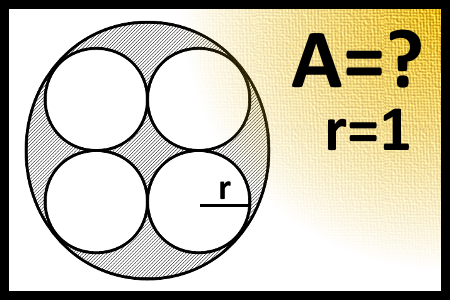
Find the area of the shaded figure
[211] Find the area of the shaded figure - Express result to the accuracy of 2 decimal. - #brainteasers #math - Correct Answers: 69 - The first user who solved this task is Djordje Timotijevic
BRAIN TEASERS
enter your answer and press button OK

Find the area of the shaded figure

Express result to the accuracy of 2 decimal.
Correct answers: 69
The first user who solved this task is Djordje Timotijevic.
#brainteasers #math
Register with your Google Account and start collecting points.
Check your ranking on list.

Final Exam

A college teacher reminds her class of tomorrow's final exam. 'Now class, I won't tolerate any excuses for you not being here tomorrow. I might consider a nuclear attack or a serious personal injury, illness, or a death in your immediate family, but that's it, no other excuses whatsoever!'
A smart-ass student in the back of the room raised his hand and asked, 'What would you say if tomorrow I said I was suffering from complete and utter sexual exhaustion?'
The entire class is reduced to laughter and snickering. When silence was restored, the teacher smiled knowingly at the student, shook her head and sweetly said, 'Well, I guess you'd have to write the exam with your other hand.'

Jokes of the day - Daily updated jokes. New jokes every day.
Follow Brain Teasers on social networks

Brain Teasers

puzzles, riddles, mathematical problems, mastermind, cinemania...

Frozen fish

In 1927, frozen fish fingers were patented in the UK by Clarence Birdseye of Gloucester, Mass. He claimed "Improvements in Methods of Preparing Fish Foods," specifically using the flesh of "cleaned fresh fish" (UK patent 257,222). As a trapper and biologist in Labrador (1912-15), Birdseye had noticed that fish and caribou meat frozeb for months tasted as good as fresh food. Slow freezing of food produces large ice crystals, which when thawed produces a very soggy material. However, he realized fish exposed in the sub-zero temperature of Labrador froze solid almost immediately froze solid. At home in his laboratory he tried for eight years to recreate the effects of nature until he developed a satisfactory commercial system of quick freezing. *
This site uses cookies to store information on your computer. Some are essential to help the site properly. Others give us insight into how the site is used and help us to optimize the user experience. See our privacy policy.