Find the right combination
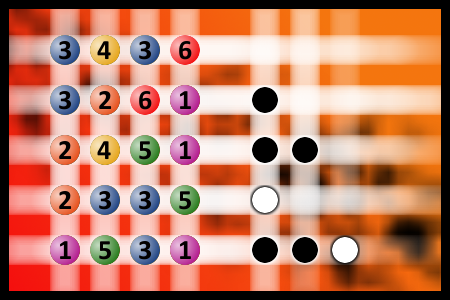
[1358] Find the right combination - The computer chose a secret code (sequence of 4 digits from 1 to 6). Your goal is to find that code. Black circles indicate the number of hits on the right spot. White circles indicate the number of hits on the wrong spot. - #brainteasers #mastermind - Correct Answers: 68 - The first user who solved this task is James Lillard
BRAIN TEASERS
enter your answer and press button OK

Find the right combination

The computer chose a secret code (sequence of 4 digits from 1 to 6). Your goal is to find that code. Black circles indicate the number of hits on the right spot. White circles indicate the number of hits on the wrong spot.
Correct answers: 68
The first user who solved this task is James Lillard.
#brainteasers #mastermind
Register with your Google Account and start collecting points.
Check your ranking on list.

A woman walked up to a little...

A woman walked up to a little old man rocking in a chair on his porch.
"I couldn't help noticing how happy you look," she said. "What's your secret for a long happy life?"
"I smoke three packs of cigarettes a day," he said. "I also drink a case of whiskey a week, eat fatty foods, and never exercise."
"That's amazing," the woman said. "How old are you?"
"Twenty-six," he said.
Jokes of the day - Daily updated jokes. New jokes every day.
Follow Brain Teasers on social networks

Brain Teasers

puzzles, riddles, mathematical problems, mastermind, cinemania...

Johann Gottfried Galle

Born 9 Jun 1812; died 10 Jul 1910 at age 98. German astronomer who on 23 Sep 1846, was the first to observe the planet Neptune, whose existence had been predicted in the calculations of Leverrier. Leverrier had written to Galle asking him to search for the 'new planet' at a predicted location. Galle was then a member of the staff of the Berlin Observatory and had discovered three comets. In 1838, while assistant to Johann Franz Encke, Galle discovered the dark, inner C ring of Saturn at the time of the maxium ring opening. In 1851, he became professor of astronomy at Breslau and director of the observatory there. In 1872, he proposed the use of asteroids rather than regular planets for determinations of the solar parallax, a suggestion which was successful in an international campaign (1888-89).
This site uses cookies to store information on your computer. Some are essential to help the site properly. Others give us insight into how the site is used and help us to optimize the user experience. See our privacy policy.