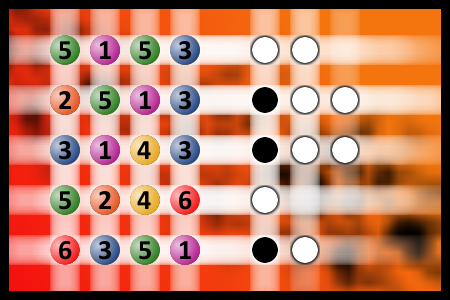
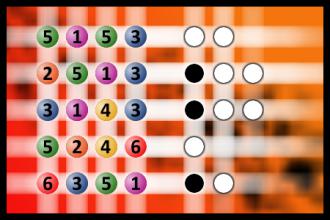
Find the right combination
[1547] Find the right combination - The computer chose a secret code (sequence of 4 digits from 1 to 6). Your goal is to find that code. Black circles indicate the number of hits on the right spot. White circles indicate the number of hits on the wrong spot. - #brainteasers #mastermind - Correct Answers: 48 - The first user who solved this task is James Lillard
BRAIN TEASERS
enter your answer and press button OK

Find the right combination

The computer chose a secret code (sequence of 4 digits from 1 to 6). Your goal is to find that code. Black circles indicate the number of hits on the right spot. White circles indicate the number of hits on the wrong spot.
Correct answers: 48
The first user who solved this task is James Lillard.
#brainteasers #mastermind
Register with your Google Account and start collecting points.
Check your ranking on list.

Talking clock

While proudly showing off his new fraternity house to friends, a college student led the way into the den. "What is the big brass gong and hammer for?" one of his friends asked.

"That's the talking clock", the man replied, with a grin. "Let me show you how it works!" And with that, he gave the gong an ear-shattering pound with the hammer.

Suddenly someone screamed from the other side of the wall, "KNOCK IT OFF, YOU IDIOT! IT'S 2 AM!"

Jokes of the day - Daily updated jokes. New jokes every day.
Follow Brain Teasers on social networks

Brain Teasers

puzzles, riddles, mathematical problems, mastermind, cinemania...

Svedberg's colloidal sol patent

In 1909, Swedish chemist Theodor Svedberg filed to patent his method of producing colloidal sols or gels, simultaneously in Great Britain, Germany, Denmark and Switzerland. By 1926, he received the Nobel Prize in Chemistry for his work with disperse systems. In colloidal systems, extremely fine particles are dispersed in a continuous medium, in which they remain suspended indefinitely. In molecular-disperse systems, the particles are large molecules like proteins or haemoglobin. Svedberg invented an ultracentrifuge to investigate them. At 40,000 revolutions/min, the particles were redistributed towards the periphery of the motion. Analysis of photographs of the distribution yielded the molecular weight of the particles.«
This site uses cookies to store information on your computer. Some are essential to help the site properly. Others give us insight into how the site is used and help us to optimize the user experience. See our privacy policy.