Find the right combination
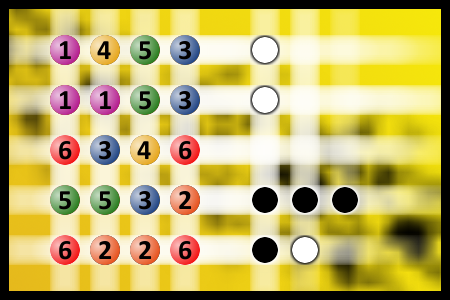
[445] Find the right combination - The computer chose a secret code (sequence of 4 digits from 1 to 6). Your goal is to find that code. Black circles indicate the number of hits on the right spot. White circles indicate the number of hits on the wrong spot. - #brainteasers #mastermind - Correct Answers: 72 - The first user who solved this task is Sanja Šabović
BRAIN TEASERS
enter your answer and press button OK

Find the right combination

The computer chose a secret code (sequence of 4 digits from 1 to 6). Your goal is to find that code. Black circles indicate the number of hits on the right spot. White circles indicate the number of hits on the wrong spot.
Correct answers: 72
The first user who solved this task is Sanja Šabović.
#brainteasers #mastermind
Register with your Google Account and start collecting points.
Check your ranking on list.

An out-of-towner drove his car...

An out-of-towner drove his car into a ditch in a desolated area. Luckily, a local farmer came to help with his big strong horse named Buddy. He hitched Buddy up to the car and yelled, "Pull, Nellie, pull!" Buddy didn't move. Then the farmer hollered, "Pull, Buster, pull!" Buddy didn't respond. Once more the farmer commanded, "Pull, Coco, pull!" Nothing. Then the farmer nonchalantly said, "Pull, Buddy, pull!" And the horse easily dragged the car out of the ditch.
The motorist was most appreciative and very curious. He asked the farmer why he called his horse by the wrong name three times.
"Well... Buddy is blind and if he thought he was the only one pulling, he wouldn't even try!"
Jokes of the day - Daily updated jokes. New jokes every day.
Follow Brain Teasers on social networks

Brain Teasers

puzzles, riddles, mathematical problems, mastermind, cinemania...

Charles Dillon Perrine

Born 28 Jul 1867; died 21 Jul 1951 at age 83.U.S. astronomer who discovered the sixth and seventh moons of Jupiter in 1904 and 1905, respectively. In 1904 he published a calculation of the solar parallax (a measure of the Earth-Sun distance) based on observations of the minor planet Eros during one of its close approaches to the Earth.
This site uses cookies to store information on your computer. Some are essential to help the site properly. Others give us insight into how the site is used and help us to optimize the user experience. See our privacy policy.