
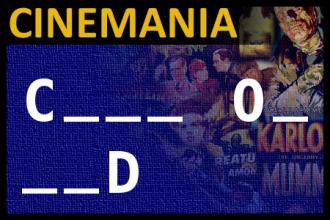
CINEMANIA: Guess the movie title
[447] CINEMANIA: Guess the movie title - Two boys growing up in a violent neighborhood of Rio de Janeiro take different paths: one becomes a photographer, the other a drug dealer. Film was made in 2002. - #brainteasers #movie #film #cinemania - Correct Answers: 58 - The first user who solved this task is Djordje Timotijevic
BRAIN TEASERS
enter your answer and press button OK

CINEMANIA: Guess the movie title

Two boys growing up in a violent neighborhood of Rio de Janeiro take different paths: one becomes a photographer, the other a drug dealer. Film was made in 2002.
Correct answers: 58
The first user who solved this task is Djordje Timotijevic.
#brainteasers #movie #film #cinemania
Register with your Google Account and start collecting points.
Check your ranking on list.

World Translation Day Jokes

On 30th September we celebrate World Translation Day! Find jokes about it below:

What do you call a translator who is always on time?

A punctual linguist.

A linguistics professor was lecturing his class the other day. “In English,” he said, “a double negative forms a positive.
However, in some languages, such as Russian, a double negative remains a negative. But there isn’t a single language, not one, in which a double positive can express a negative.”
A voice from the back of the room retorted, “Yeah, right.”

Two translators on a ship are talking.“Can you swim?” asks one.“No” says the other, “but I can shout for help in nine languages.”

#worldtranslationday
Jokes of the day - Daily updated jokes. New jokes every day.
Follow Brain Teasers on social networks

Brain Teasers

puzzles, riddles, mathematical problems, mastermind, cinemania...

Royal Greenwich Observatory

In 1675, the Royal Greenwich Observatory was created by Royal Warrant in England by Charles II. Building designed by Sir Christopher Wren (who was also a Professor of Astronomy) was commenced 10 Aug 1675 and finished the following year by John Flamsteed was appointed as the first Astronomer Royal. Its primary uses were in practical astronomy - navigation, timekeeping, determination of star positions. In 1767 the observatory began publishing The Nautical Almanac, which established the longitude of Greenwich as a baseline for time calculations. The almanac's popularity among navigators led in part to the adoption (1884) of the Greenwich meridian as the Earth's prime meridian (0° longitude) and the international time zones.
This site uses cookies to store information on your computer. Some are essential to help the site properly. Others give us insight into how the site is used and help us to optimize the user experience. See our privacy policy.