Find the right combination
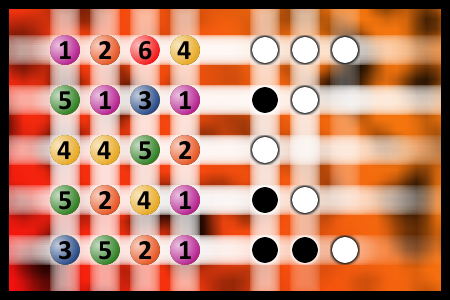
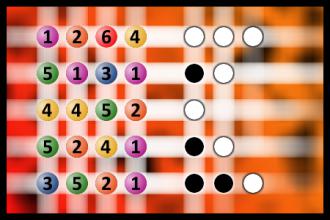
[620] Find the right combination - The computer chose a secret code (sequence of 4 digits from 1 to 6). Your goal is to find that code. Black circles indicate the number of hits on the right spot. White circles indicate the number of hits on the wrong spot. - #brainteasers #mastermind - Correct Answers: 79 - The first user who solved this task is Sanja Šabović
BRAIN TEASERS
enter your answer and press button OK

Find the right combination

The computer chose a secret code (sequence of 4 digits from 1 to 6). Your goal is to find that code. Black circles indicate the number of hits on the right spot. White circles indicate the number of hits on the wrong spot.
Correct answers: 79
The first user who solved this task is Sanja Šabović.
#brainteasers #mastermind
Register with your Google Account and start collecting points.
Check your ranking on list.

Moths

A woman was having a passionate affair with an inspector from pest-control company. One afternoon they were carrying on in the bedroom together when her husband arrived home unexpectedly. "Quick," said the woman to her lover, "into the closet!", and she pushed him into the closet stark naked. The husband, however, became suspicious and after a search of the bedroom discovered the man in the closet. "Who are you?" he asked him.
"I'm an inspector from Bugs-B-Gone," said the exterminator.
What are you doing in there?" the husband asked.
I'm investigating a complaint about an infestation of moths," the man replied.
"And where are your clothes?" asked the husband.
The man looked down at himself and said, "Those little bastards!"

Jokes of the day - Daily updated jokes. New jokes every day.
Follow Brain Teasers on social networks

Brain Teasers

puzzles, riddles, mathematical problems, mastermind, cinemania...

Argand diagram

In 1797, the concept of a geometrical interpretation of complex numbers was submitted by Caspar Wessel in a paper to a meeting of the Royal Danish Academy of Sciences.He represented complex numbers as points in a Cartesian plane, with the real portion of the number on the x axis and the imaginary part on the y axis. This was also independently devised a few years later, by Jean-Robert Argand, an amateur mathematician who self-published his ideas in an anomymous monograph(1806). Through publicity generated when Argand came forward and identified himself as the author, it was his name that has the lasting association with the Argand diagram.«
This site uses cookies to store information on your computer. Some are essential to help the site properly. Others give us insight into how the site is used and help us to optimize the user experience. See our privacy policy.