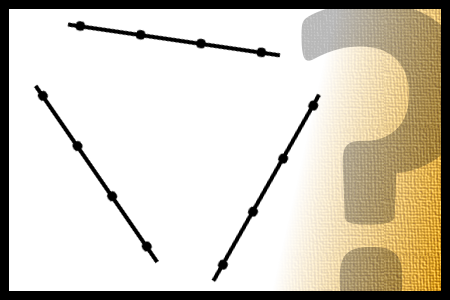
How many triangles can be formed from the given points?
[294] How many triangles can be formed from the given points? - Author: Nebojsa Jevtovic (Serbia) - #brainteasers #math - Correct Answers: 43 - The first user who solved this task is Sanja Šabović
BRAIN TEASERS
enter your answer and press button OK

How many triangles can be formed from the given points?

Author: Nebojsa Jevtovic (Serbia)
Correct answers: 43
The first user who solved this task is Sanja Šabović.
#brainteasers #math
Register with your Google Account and start collecting points.
Check your ranking on list.

Genie's Map

A woman rubbed a bottle and out popped a genie. The amazed woman asked if she got three wishes.
The genie said, "Nope, sorry, three-wish genies are a storybook myth. I'm a one-wish genie. So... what'll it be?"
The woman did not hesitate. She said, "I want peace in the Middle East. See this map? I want these countries to stop fighting with each other and I want all the Arabs to love the Jews and Americans and vice-versa. It will bring about world peace and harmony."
The genie looked at the map and exclaimed, "Lady, be reasonable. These countries have been at war for thousands of years. I'm out of shape after being in a bottle for five hundred years.. I'm good but not THAT good!
I don't think it can be done. Make another wish and please be reasonable."
The woman thought for a minute and said, "Well, I've never been able to find the right man. You know, one that's considerate and fun, romantic, likes to cook and help with the house cleaning, is good in bed, and gets along with my family, doesn't watch sports all the time, and is faithful.
That is what I wish for...a good man."

The genie let out a sigh and said, "Let me see the f*cking map again."

Jokes of the day - Daily updated jokes. New jokes every day.
Follow Brain Teasers on social networks

Brain Teasers

puzzles, riddles, mathematical problems, mastermind, cinemania...

Wolfgang Paul

Died 6 Dec 1993 at age 80 (born 10 Aug 1913).German physicist who developed the Paul trap, an electromagnetic device that captures ions and holds them long enough for study and precise measurement of their properties. During the 1950s he developed the so-called Paul trap as a means of confining and studying electrons. The device consists of three electrodes - two end caps and an encircling ring. The ring is connected to an oscillating potential. The direction of the electric field alternates; for half the time the electron is pushed from the caps to the ring and for the other half it is pulled from the ring and pushed towards the caps. For his work he shared the 1989 Nobel Prize for Physics with Hans Georg Dehmelt and Norman F. Ramsey.
This site uses cookies to store information on your computer. Some are essential to help the site properly. Others give us insight into how the site is used and help us to optimize the user experience. See our privacy policy.