What a winning combination?
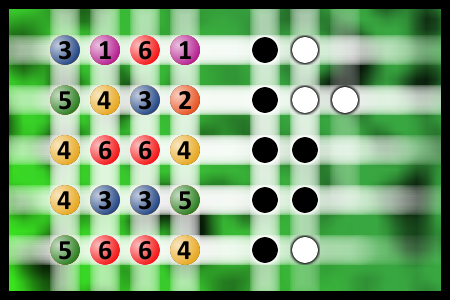
[292] What a winning combination? - The computer chose a secret code (sequence of 4 digits from 1 to 6). Your goal is to find that code. Black circles indicate the number of hits on the right spot. White circles indicate the number of hits on the wrong spot. - #brainteasers #mastermind - Correct Answers: 67 - The first user who solved this task is Sanja Šabović
BRAIN TEASERS
enter your answer and press button OK

What a winning combination?

The computer chose a secret code (sequence of 4 digits from 1 to 6). Your goal is to find that code. Black circles indicate the number of hits on the right spot. White circles indicate the number of hits on the wrong spot.
Correct answers: 67
The first user who solved this task is Sanja Šabović.
#brainteasers #mastermind
Register with your Google Account and start collecting points.
Check your ranking on list.

A woman goes to Spain to atten...

A woman goes to Spain to attend a 2-week, company training session. Her husband drives her to the airport and wishes her to have a good trip.
The wife answers: "Thank you honey, what would you like me to bring for you?"
The husband laughs and says: "A Spanish girl!"
The woman kept quiet and left.
Two weeks later he picks her up in the airport and asks:
"So, honey, how was the trip?"
"Very good, thank you."
"And, what happened to my present?"
"Which present?" She asked.
"The one I asked for - a Spanish girl!!"
"Oh, that," she said "Well, I did what I could; now we'll have to wait for a few months to see if it is a boy or a girl!"
Jokes of the day - Daily updated jokes. New jokes every day.
Follow Brain Teasers on social networks

Brain Teasers

puzzles, riddles, mathematical problems, mastermind, cinemania...

Sofia Kovalevskaya

Born 15 Jan 1850; died 10 Feb 1891 at age 41. Russian mathematician and novelist who was the first major female Russian educated in the subject. She wrote that she was immersed from an early age: while just age 11, the walls of her nursery were papered with pages of calculus lecture notes, (said to be due to a shortage of wallpaper) from which she learned For university studies, she could only attend lectures unofficially, since women were not allowed to matriculate at Heidelberg. Nevertheless, by 1889, she became the first female full professor in Europe. She made valuable contributions to the theory of differential equations. At the early age of 41, while still at the peak of her mathematical ability and renown, Kovalevskaya died of influenza complicated by pneumonia.«a.k.a. Sofya, Sonya or Sophie, and as Kovalevsky.
This site uses cookies to store information on your computer. Some are essential to help the site properly. Others give us insight into how the site is used and help us to optimize the user experience. See our privacy policy.