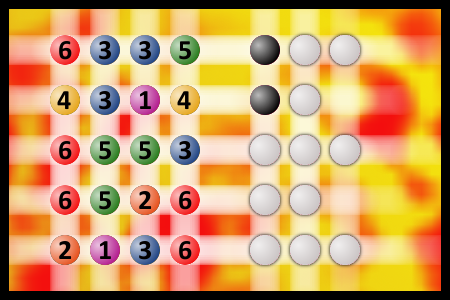
What a winning combination?
[1] What a winning combination? - What a winning combination? - #brainteasers #mastermind #riddles - Correct Answers: 98 - The first user who solved this task is Sanja Šabović
BRAIN TEASERS
enter your answer and press button OK

What a winning combination?

What a winning combination?
Correct answers: 98
The first user who solved this task is Sanja Šabović.
#brainteasers #mastermind #riddles
Register with your Google Account and start collecting points.
Check your ranking on list.

I don’t have an amazing figure or a flat stomach

I don’t have an amazing figure or a flat stomach. I’m far from being considered a model but, I’m me. I eat food. I have curves. I have more fat than I should. I have scars because I have a history. Some people love me, some like me, some hate me. I have done good. I have done bad. I love my Pj’s and I go without makeup and sometimes don’t get my hair done. I’m random and sometimes I say crazy things. I don’t pretend to be someone I’m not. I am who I am, you can love me or not. I won’t change! And if I love you…I do it with all my Heart! I make no apologies for who I am.
Jokes of the day - Daily updated jokes. New jokes every day.
Follow Brain Teasers on social networks

Brain Teasers

puzzles, riddles, mathematical problems, mastermind, cinemania...

Peter Andreas Hansen

Died 28 Mar 1874 at age 78 (born 8 Dec 1795).Danish astronomer whose most important work was the improvement of the theories and tables of the orbits of the principal bodies in the solar system. At Altona observatory he assisted in measuring the arc of meridian (1821). He became the director (1825) of Seeberg observatory, which was removed to Gotha in a new observatory built for him (1857). He worked on theoretical geodesy, optics, and the theory of probability. The work in celestial mechanics for which he is best known are his theories of motion for comets, minor planets, moon and his lunar tables (1857) which were in use until 1923. He published his lunar theory in Fundamenta ("Foundation") in 1838, and Darlegung ("Explanation") in 1862-64.
This site uses cookies to store information on your computer. Some are essential to help the site properly. Others give us insight into how the site is used and help us to optimize the user experience. See our privacy policy.