What a winning combination?
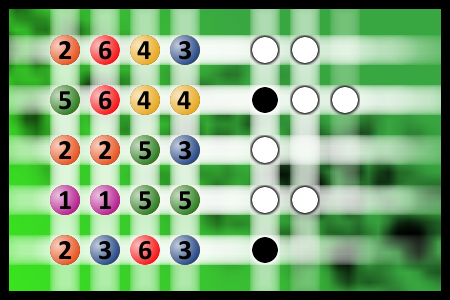
[773] What a winning combination? - The computer chose a secret code (sequence of 4 digits from 1 to 6). Your goal is to find that code. Black circles indicate the number of hits on the right spot. White circles indicate the number of hits on the wrong spot. - #brainteasers #mastermind - Correct Answers: 60 - The first user who solved this task is Sanja Šabović
BRAIN TEASERS
enter your answer and press button OK

What a winning combination?

The computer chose a secret code (sequence of 4 digits from 1 to 6). Your goal is to find that code. Black circles indicate the number of hits on the right spot. White circles indicate the number of hits on the wrong spot.
Correct answers: 60
The first user who solved this task is Sanja Šabović.
#brainteasers #mastermind
Register with your Google Account and start collecting points.
Check your ranking on list.

After spending a night at a ho...

After spending a night at a hotel with a prostitute, the politician took $300 out of his wallet and placed it on the dressing table.
"Thanks," she said. "But I only charge $20."
"Twenty bucks for the entire night?" the amazed politician replied. "You can't make a living on that."
"Oh, don't worry," the whore replied. "I do a little blackmail on the side!"
Jokes of the day - Daily updated jokes. New jokes every day.
Follow Brain Teasers on social networks

Brain Teasers

puzzles, riddles, mathematical problems, mastermind, cinemania...

Legionnaire's disease

In 1977, the isolation of the bacterium Legionella pneumophila that was the cause of Legionnaire's Disease, was described in a scientific paper published in The New England Journal of Medicine by scientists at the Centers for Disease Control (CDC) in Atlanta, Georgia, USA*. They had first announced that they had sufficient laboratory evidence to implicate a bacterium on 18 Jan 1977 as responsible for an outbreak of this disease in Philadelphia in 1976, largely among people attending a state convention of the American Legion, which led to the name "Legionnaires' Disease." After the bacterium causing the illness was named, the name of the illness was changed to legionellosis.[Image: Legionella pneumophila multiplying inside a cultured human lung fibroblast. Multiple intracellular bacilli, including dividing bacilli, are visible in longitudinal and cross section. Transmission electron micrograph.]
This site uses cookies to store information on your computer. Some are essential to help the site properly. Others give us insight into how the site is used and help us to optimize the user experience. See our privacy policy.