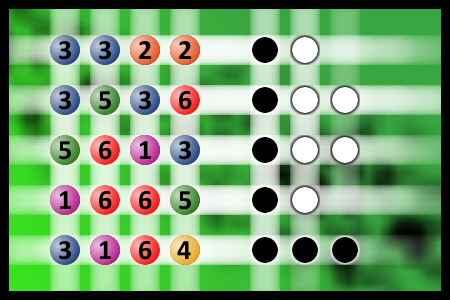
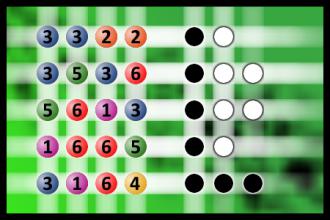
Which is a winning combination of digits?
[1109] Which is a winning combination of digits? - The computer chose a secret code (sequence of 4 digits from 1 to 6). Your goal is to find that code. Black circles indicate the number of hits on the right spot. White circles indicate the number of hits on the wrong spot. - #brainteasers #mastermind - Correct Answers: 66 - The first user who solved this task is James Lillard
BRAIN TEASERS
enter your answer and press button OK

Which is a winning combination of digits?

The computer chose a secret code (sequence of 4 digits from 1 to 6). Your goal is to find that code. Black circles indicate the number of hits on the right spot. White circles indicate the number of hits on the wrong spot.
Correct answers: 66
The first user who solved this task is James Lillard.
#brainteasers #mastermind
Register with your Google Account and start collecting points.
Check your ranking on list.

Short Jokes, Long Laughs

I wanted to marry my English teacher when she got out of jail
But apparently you can't end a sentence with a proposition.

19 and 20 had a fight...
21...
19 was injured, 22.

A young boy asked his father if he could try coffee
The dad said “sure son! Have a sip.”
The boy took a sip and immediately spit it out. “Yuck!” he said, “this tastes like dirt!”
“We’ll of course it does, son. It was ground this morning!”

I hate it when you're on the toilet and you notice there is no toilet paper left. Then you have to walk with your trousers round your ankles to get another roll… Anyway, I'm nearly at the Walmart now!

Jokes of the day - Daily updated jokes. New jokes every day.
Follow Brain Teasers on social networks

Brain Teasers

puzzles, riddles, mathematical problems, mastermind, cinemania...

Josef Leopold Auenbrugger

Died 17 May 1809 at age 86 (born 19 Nov 1722). Austrian physician who devised the diagnostic technique of percussion (the art of striking a surface part of the body with short, sharp taps to diagnose the condition of the parts beneath the sound). With this technique, he could estimate the amount of fluid in a patient's chest and the size of his/her heart. (As a boy he had tapped the wine barrels in his father's cellar to find how full they were.) After seven years of investigation, he published the method in Inventum Novum (1761), though his technique did not gain recognition and acceptance until years after his death. When a translator republished the work in French (1808) the method gained acceptance around the world, and through time to the present as a fundamental diagnostic procedure.
This site uses cookies to store information on your computer. Some are essential to help the site properly. Others give us insight into how the site is used and help us to optimize the user experience. See our privacy policy.