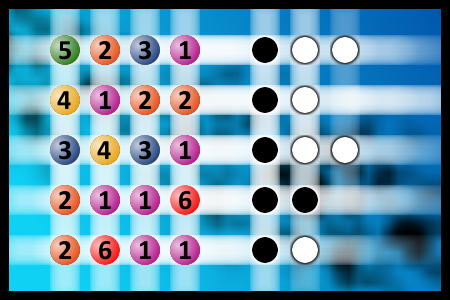
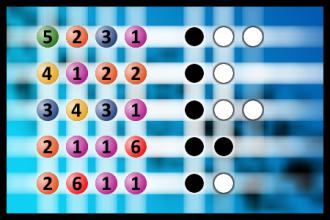
Which is a winning combination of digits?
[406] Which is a winning combination of digits? - The computer chose a secret code (sequence of 4 digits from 1 to 6). Your goal is to find that code. Black circles indicate the number of hits on the right spot. White circles indicate the number of hits on the wrong spot. - #brainteasers #mastermind - Correct Answers: 62 - The first user who solved this task is Sanja Šabović
BRAIN TEASERS
enter your answer and press button OK

Which is a winning combination of digits?

The computer chose a secret code (sequence of 4 digits from 1 to 6). Your goal is to find that code. Black circles indicate the number of hits on the right spot. White circles indicate the number of hits on the wrong spot.
Correct answers: 62
The first user who solved this task is Sanja Šabović.
#brainteasers #mastermind
Register with your Google Account and start collecting points.
Check your ranking on list.

How About a Drink?

A Jesuit was out for a drive and crashed into another car, only to discover that the other driver was a Franciscan.“It was my fault,” each insisted—as is only right and proper with religious men.Concerned, the Jesuit said, “You look badly shaken up, Father. You could probably use a good stiff drink right now to calm down.”He produced a flask and the Franciscan drank from it and said, “Thank you, Father; I feel much better now. But you’re probably shaken up too. Why don’t you have a drink as well?” “I will,” the Jesuit replied, “but I think I’ll wait until after the police have come.”
Jokes of the day - Daily updated jokes. New jokes every day.
Follow Brain Teasers on social networks

Brain Teasers

puzzles, riddles, mathematical problems, mastermind, cinemania...

Comte Claude Louis Berthollet

Born 9 Dec 1748; died 6 Nov 1822 at age 73.French chemist who was the first to note that the completeness of chemical reactions depends in part upon the masses of the reacting substances (1803); he thus came close to formulating the law of mass action. Though he incorrectly concluded that elements unite in all proportions, his resulting controversy with the chemist Joseph-Louis Proust led to the establishment of the law of definite proportions. He continued Carl Scheele's research on chlorine, showing in 1785 how it could be used for bleaching. He continued Joseph Priestley's investigation of ammonia, and was the first to show it was a compound of hydrogen and nitrogen. He discovered potassium chlorate.
This site uses cookies to store information on your computer. Some are essential to help the site properly. Others give us insight into how the site is used and help us to optimize the user experience. See our privacy policy.