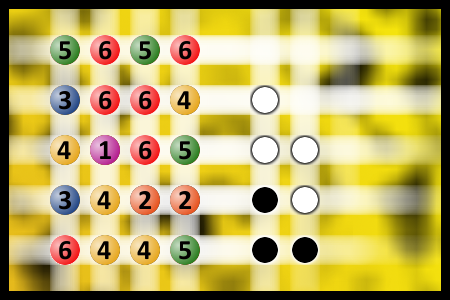
Which is a winning combination of digits?
[630] Which is a winning combination of digits? - The computer chose a secret code (sequence of 4 digits from 1 to 6). Your goal is to find that code. Black circles indicate the number of hits on the right spot. White circles indicate the number of hits on the wrong spot. - #brainteasers #mastermind - Correct Answers: 75 - The first user who solved this task is Sanja Šabović
BRAIN TEASERS
enter your answer and press button OK

Which is a winning combination of digits?

The computer chose a secret code (sequence of 4 digits from 1 to 6). Your goal is to find that code. Black circles indicate the number of hits on the right spot. White circles indicate the number of hits on the wrong spot.
Correct answers: 75
The first user who solved this task is Sanja Šabović.
#brainteasers #mastermind
Register with your Google Account and start collecting points.
Check your ranking on list.

A man goes into a seafood rest...

A man goes into a seafood restaurant and sees a sign that reads: "Big Red Lobster Tails - $1."
Amazed at the value of the offer, he calls a waitress over. "Excuse me," he said. "Is that sign correct?"
"Yes sir," she replied. "It's today's special offer."
"Fantastic," said the man. "But are you sure they're not small?"
"Oh no sir, I can assure you that they are very big."
"Are they out of date then?"
"No, no sir, they are fresh in this morning."
"Well in that case, here's my $1. Fill me up."

The waitress took the $1 coin, sat down beside him and said, "Once upon a time, there was a big red lobster..."
Jokes of the day - Daily updated jokes. New jokes every day.
Follow Brain Teasers on social networks

Brain Teasers

puzzles, riddles, mathematical problems, mastermind, cinemania...

Heinrich Rohrer

Born 6 Jun 1933.Swiss physicist who, with Gerd Binnig, received half of the 1986 Nobel Prize for Physics for their joint invention of the scanning tunneling microscope. (Ernst Ruska received the other half of the prize.) Ruska's electron microscope of the 1930s was unable to show surface structure at the atomic level. Rohrer and Binnig began work in 1978 on a scanning tunneling microscope in which a fine probe passes within a few angstroms of the surface of the sample. A positive voltage on the probe enables electrons to move from the sample to the probe by the tunnel effect, and the detected current can used to keep the probe at a constant distance from the surface. As the probe moves in parallel lines, a 3D image of the surface can be constructed.
This site uses cookies to store information on your computer. Some are essential to help the site properly. Others give us insight into how the site is used and help us to optimize the user experience. See our privacy policy.