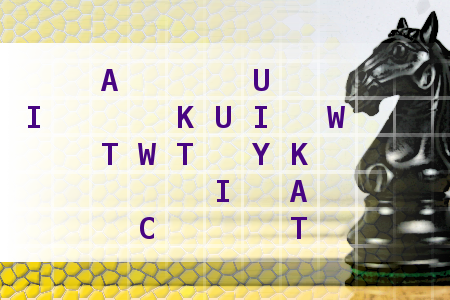
Chess Knight Move
[3191] Chess Knight Move - Find the country and its capital city, using the move of a chess knight. First letter is K. Length of words in solution: 6,6,4. - #brainteasers #wordpuzzles #chessknightmove - Correct Answers: 65 - The first user who solved this task is On On Lunarbasil
BRAIN TEASERS
enter your answer and press button OK

Chess Knight Move

Find the country and its capital city, using the move of a chess knight. First letter is K. Length of words in solution: 6,6,4.
Correct answers: 65
The first user who solved this task is On On Lunarbasil.
#brainteasers #wordpuzzles #chessknightmove
Register with your Google Account and start collecting points.
Check your ranking on list.

Coffee Maker

The newlywed Blonde went to the store to ask how to operate the new coffeemaker received as a wedding gift. The salesman carefully explained how everything worked; how to plug it in, set the timer, go to bed, and upon rising, the coffee is ready.

A few weeks later the goober was back in the store and the salesman asked her how she liked the coffee maker.

"Wonderful!" she replied, "But... it's just awfully inconvenient to have to go to bed every time I want to make a pot of coffee."

Jokes of the day - Daily updated jokes. New jokes every day.
Follow Brain Teasers on social networks

Brain Teasers

puzzles, riddles, mathematical problems, mastermind, cinemania...

John Aitken

Born 18 Sep 1839; died 14 Nov 1919 at age 80.Scottish physicist and meteorologist who is known for his studies on atmospheric dust, the formation of dew, cyclones and evaporation. He invented the koniscope to detect and study atmospheric dust particles. He determined that condensation of atmospheric water vapor from clouds and fogs begins on the surface of microscopic particles (now known as Aitken nuclei) as a crucial step in the formation of rain and dew. Combustion produces a profusion of such particles. Suffering from ill health, he worked from a laboratory in his Falkirk home. Much of his work was published in the journals of the Royal Society of Edinburgh.«
This site uses cookies to store information on your computer. Some are essential to help the site properly. Others give us insight into how the site is used and help us to optimize the user experience. See our privacy policy.