Chess Knight Move
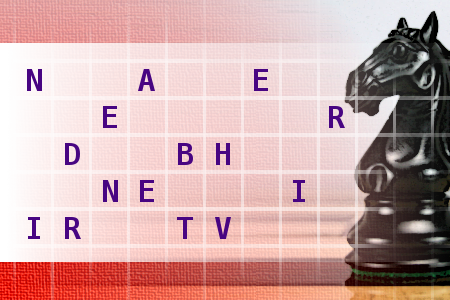
[5361] Chess Knight Move - Find the title of novel, using the move of a chess knight. First letter is A. Length of words in solution: 1,4,2,3,5. - #brainteasers #wordpuzzles #chessknightmove - Correct Answers: 32 - The first user who solved this task is Djordje Timotijevic
BRAIN TEASERS
enter your answer and press button OK

Chess Knight Move

Find the title of novel, using the move of a chess knight. First letter is A. Length of words in solution: 1,4,2,3,5.
Correct answers: 32
The first user who solved this task is Djordje Timotijevic.
#brainteasers #wordpuzzles #chessknightmove
Register with your Google Account and start collecting points.
Check your ranking on list.

World Voice Day Jokes

Today is World Voice Day! Find a joke about it!

If a pig loses its voice…
Is it disgruntled?

I lost my voice today.
I can't tell you how annoying it is.

How many voice actors does it take to change a light bulb?
Six. One to do it, and five to say, “I was offered that job!”

What do you call a narrator's favourite pair of pants?
Long story shorts.

#worldvoiceday

Jokes of the day - Daily updated jokes. New jokes every day.
Follow Brain Teasers on social networks

Brain Teasers

puzzles, riddles, mathematical problems, mastermind, cinemania...

Reginald C. Punnett

Died 3 Jan 1967 at age 91 (born 20 Jun 1875). Reginald Crundall Punnett was an English geneticist who, with the English biologist William Bateson, were among the first English Mendelian geneticists. They reported the discovery of two new genetic principles: the first account of genetic linkage in sweet pea; and gene interaction (1905). Punnett devised the Punnett square to depict the number and variety of genetic combinations. Punnett had a role in connecting Mendelism with statistics. In 1908, Punnett was asked at a lecture to explain, “ if brown eyes were dominant, then why wasn't the whole country becoming brown-eyed?” Punnett in turn asked his friend the mathematician, G. H. Hardy. Out of this conversation came the Hardy-Weinberg Law which calculates how population affects genetic inheritance.
This site uses cookies to store information on your computer. Some are essential to help the site properly. Others give us insight into how the site is used and help us to optimize the user experience. See our privacy policy.