Find a famous person
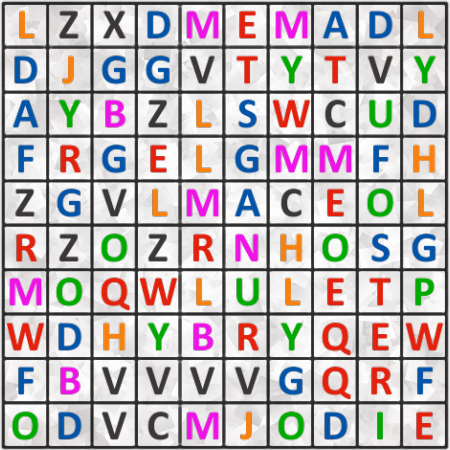
[3863] Find a famous person - Find the first and the last name of a famous person. Text may go in all 8 directions. Length of words in solution: 5,6. - #brainteasers #wordpuzzles - Correct Answers: 35 - The first user who solved this task is Manguexa Wagle
BRAIN TEASERS
enter your answer and press button OK

Find a famous person

Find the first and the last name of a famous person. Text may go in all 8 directions. Length of words in solution: 5,6.
Correct answers: 35
The first user who solved this task is Manguexa Wagle.
#brainteasers #wordpuzzles
Register with your Google Account and start collecting points.
Check your ranking on list.

Things to do @ Wal-Mart w...

Things to do @ Wal-Mart while the significant other is taking his/her sweet time:

1. Look right into the security camera, and use it as a mirror while you pick your nose.
2. Take up an entire aisle in Toys by setting up a full scale battlefield with G. I. Joe's vs. the X-Men.
3. Ask other customers if they have any Grey Poupon.
4. Switch the men's and women's signs on the doors of the restroom.
5. Dart around suspiciously while humming the theme from "Mission Impossible."
6. Set up a "Valet Parking" sign in front of the store.
7. Hide in the clothing racks and when people browse through, say things like "pick me! pick me!!"
8. If the store has a food court, buy a soft drink; explain that you don't get out much, and ask if they can put a little umbrella in it.
Jokes of the day - Daily updated jokes. New jokes every day.
Follow Brain Teasers on social networks

Brain Teasers

puzzles, riddles, mathematical problems, mastermind, cinemania...

Richard Zsigmondy

Died 23 Sep 1929 at age 64 (born 1 Apr 1865).Richard Adolf Zsigmondy was an Austro-German chemist who was awarded who was awarded the Nobel Prize for Chemistry in 1925 for “his demonstration of the heterogenous nature of colloid solutions and for the methods he used, which have since become fundamental in modern colloid chemistry."” Colloids are composed of submicroscopic particles dispersed within another substance. To conduct his research on colloids he invented the ultramicroscope (1903), with which he could view particles with a diameter of one 10-millionth of a millimetre not visible in a conventional microscope. It used an intense beam of light oriented in a position perpendicular to the microscope's optical axis. As particles scattered the incident light, their movements could be seen as flashes against a dark background.«
This site uses cookies to store information on your computer. Some are essential to help the site properly. Others give us insight into how the site is used and help us to optimize the user experience. See our privacy policy.