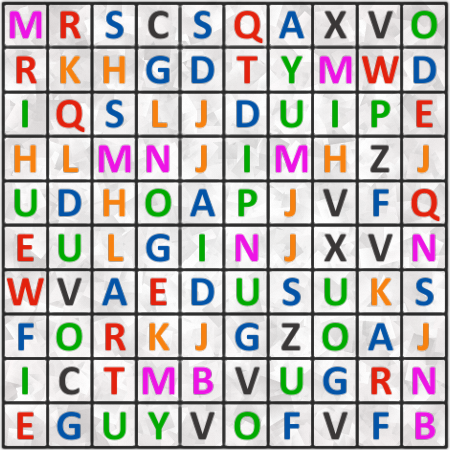
Find a famous person
Find the first and the last name of a famous person. Text may go in all 8 directions. Length of words in solution: 6,7.
14 Jokes to brighten your day
A termite walks into a bar and asks
- Is the bar tender here?
What do you call a caveman's fart?
A blast from the past.
I was having a bad day, and my friend said,
'At least you're not stuck in a hole in the ground full of water.'
I knew he meant well.
A guy walks into a doctor's office, butt ass naked, but wrapped head-to-toe in cellophane.
The doctor takes one look at the guy and says,
'Well...I can clearly see your nuts.'
- Why couldn't the lifeguard rescue the hippie?'
- Because he was too far out, man.
The chicken and the egg are in bed.
The chicken rolls over and lights a cigarette, and the egg says,
'Well, I guess that answers *that* question.'
Why does a chicken coop only have two doors?
Because if it had four, it would be a chicken sedan.
Why don't anteaters ever get sick?
Because they are full of little anty-bodies.
A tire thief is at large ...
and the police are working tirelessly to catch him.
A man went to see his doctor and the doctor said to him,
'I have some bad news and some worse news for you.'
So the man asks, 'OK, so what’s the bad news?'
The doctor says, 'You only have 24 hours to live.'
The man, obviously shocked by this, says, 'Oh my god, that’s terrible!'
Then he says, 'Wait a minute — what’s the worse news?'
Doctor: 'I should have told you yesterday.'
Two men are standing by the roadside when a tractor drives past.
The driver is ranting and shouting, 'The end of the world is nigh!'
One guy says, 'Oh no, we’re all gonna die, what shall we do?'
His friend replies, 'Don’t worry about him, that’s just Farmer Geddon!'
How many therapists does it take to change a light bulb?
Only one, but it takes a long time and the light bulb has to want to change.
How do ghosts go through locked doors?
AWith a skeleton key!
What did the zero say to the eight?
'Nice belt.'