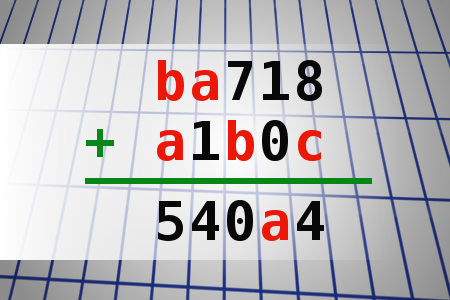
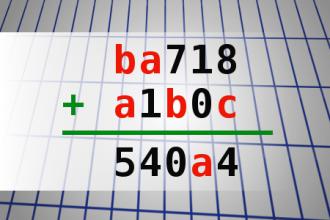
Find number abc
[2487] Find number abc - If ba718 + a1b0c = 540a4 find number abc. Multiple solutions may exist. - #brainteasers #math - Correct Answers: 94 - The first user who solved this task is Eugenio G. F. de Kereki
BRAIN TEASERS
enter your answer and press button OK

Find number abc

If ba718 + a1b0c = 540a4 find number abc. Multiple solutions may exist.
Correct answers: 94
The first user who solved this task is Eugenio G. F. de Kereki.
#brainteasers #math
Register with your Google Account and start collecting points.
Check your ranking on list.

Winning toast

PatrickĀ  hoisted his beer and said: "Here's to spending the rest of my life between the legs of me wife!"

And with that he took home the top prize for the best toast of the night.

In bed later that night, he told his wife: "Mary, I won the prize for the best toast of the night."

She said: "Aye, Paddy, what was your toast?"

So he told her: "Here's to spending the rest of my life sitting in church beside me wife."

"Oh," she said, "that is very nice, dear."

The next day, Mary ran into one of Paddy's drinking partners in the street.

Mischievously, the man said: "Did you hear about your husband winning a prize in the pub the other night for a toast about you, Mary?"

She replied: "Aye, and I was a bit surprised. Till now, he's only been down there twice. Once he fell asleep, and the other time I had to pull him by the ears to make him come."

Jokes of the day - Daily updated jokes. New jokes every day.
Follow Brain Teasers on social networks

Brain Teasers

puzzles, riddles, mathematical problems, mastermind, cinemania...

Cotton cultivator

In 1874, an “Improvement in Cotton-Cultivators” was issued a U.S. patent for its black American inventor, Edward H. Sutton, of Edenton, north Carolina (No. 149,543). A horizontal beam, mounted on wheels, had a harness coupling at the front, and carried three blades. Teeth on the forward blade were intended to loosen and pulverise the soil, followed by two blades to cut weeds. The middle of the three blades was arranged to “be rotated in such a manner as to cut the weeds or thin out the growing cotton which is beyond the reach of the stationary blade” at the back. Adjustment of the middle blade was made using a spring-loaded lever attached from to one of the operator's handles behind the plough. The short patent application was made on 10 Feb 1874, and issued less than two months later.«[Image: detail from patent drawing, showing blades.]
This site uses cookies to store information on your computer. Some are essential to help the site properly. Others give us insight into how the site is used and help us to optimize the user experience. See our privacy policy.