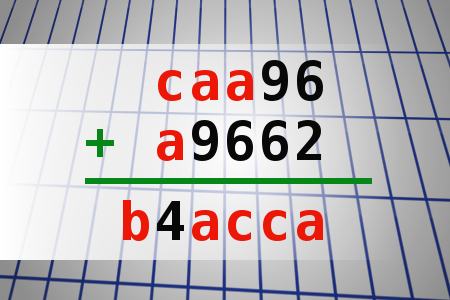
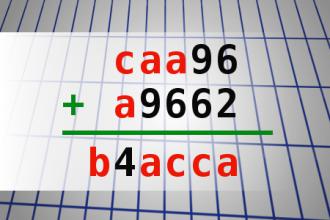
Find number abc
[3906] Find number abc - If caa96 + a9662 = b4acca find number abc. Multiple solutions may exist. - #brainteasers #math - Correct Answers: 38 - The first user who solved this task is Thinh Ddh
BRAIN TEASERS
enter your answer and press button OK

Find number abc

If caa96 + a9662 = b4acca find number abc. Multiple solutions may exist.
Correct answers: 38
The first user who solved this task is Thinh Ddh.
#brainteasers #math

Register with your Google Account and start collecting points.
Check your ranking on list.

Efficiency Expert

An efficiency expert concluded his lecture with a note of caution. "You need to be careful about trying these techniques at home."

"Why?" asked somebody from the audience.

"I watched my wife's routine at dinner for years," the expert explained. "She made lots of trips between the refrigerator, stove, table and cabinets, often carrying a single item at a time.

One day I told her, 'Honey, why don't you try carrying several things at once?'

"Did it save time?" the guy in the audience asked.

"Actually, yes," replied the expert. "It used to take her 30 minutes to make dinner.

Now I do it in ten..."

Jokes of the day - Daily updated jokes. New jokes every day.
Follow Brain Teasers on social networks

Brain Teasers

puzzles, riddles, mathematical problems, mastermind, cinemania...

Robert L. Banks

Died 3 Jan 1989 at age 67 (born 24 Nov 1921).American chemist who co-discovered crystalline polypropylene polymer, with J. Paul Hogan. They were assigned by Phillips Petroleum, in 1946, to research ways to take the natural gas products propylene and ethylene and turn them into useful gasoline components. On 5 Jun 1951, their experiments using catalysts yielded polypropylene - now used in fibers for rope, indoor-outdoor carpeting and plastics. Banks and Hogan also found how to make a new high-density polyethylene which was more heat resistant than the previously existing polyethylene. Further, their catalysts produced the new polyethylene at only a few hundred psi pressure instead of the existing free radical process which required pressures of up to 30,000 psi.«
This site uses cookies to store information on your computer. Some are essential to help the site properly. Others give us insight into how the site is used and help us to optimize the user experience. See our privacy policy.