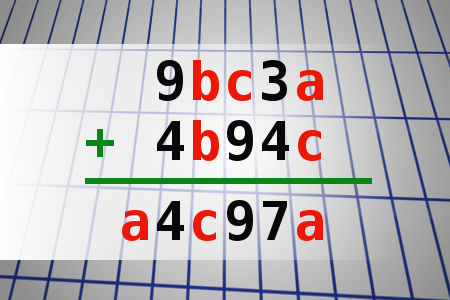
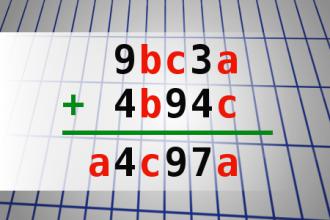
Find number abc
[5623] Find number abc - If 9bc3a + 4b94c = a4c97a find number abc. Multiple solutions may exist. - #brainteasers #math - Correct Answers: 39 - The first user who solved this task is Djordje Timotijevic
BRAIN TEASERS
enter your answer and press button OK

Find number abc

If 9bc3a + 4b94c = a4c97a find number abc. Multiple solutions may exist.
Correct answers: 39
The first user who solved this task is Djordje Timotijevic.
#brainteasers #math
Register with your Google Account and start collecting points.
Check your ranking on list.

A brunette who really hated bl...

A brunette who really hated blondes was walking through the desert when she came across a magic lamp. After rubbing the lamp the genie told her that she got three wishes with one catch: All the blondes in the world would get twice whatever she asked for. So the brunette thought a while and then wished for a million dollars.

'Every blonde in the world will get two million.' The brunette said that was fine and then she asked for an incredibly handsome man.

'Every blonde in the world will get two incredibly handsome men.'

The brunette said that was fine too and the genie granted her wishes. 'Now for your third wish.' said the genie.

'See that stick over there?', asked the brunette, 'I want you to beat me half to death with it.'

Jokes of the day - Daily updated jokes. New jokes every day.
Follow Brain Teasers on social networks

Brain Teasers

puzzles, riddles, mathematical problems, mastermind, cinemania...

Baron Edgar Douglas Adrian

Died 4 Aug 1977 at age 87 (born 30 Nov 1889). English electrophysiologist who is one of the founders of modern neurophysiology. He shared (with Sir Charles Sherrington) the Nobel Prize for Physiology or Medicine in 1932 for “for their discoveries regarding the functions of neurons.”While a student under Keith Lucas at Cambridge, Adrian discovered the “all-or-none”phenomenon (the relation between stimulus intensity and muscle-fibre contraction) in muscle-nerve preparations. During a career at Cambridge he developed the capillary electrometer to measure minute signals from nerve fibres and discovered the nature of coding of the motor and sensory impulses in afferent and efferent fibres. In the early 1930s, he advanced concepts of electro-encephalography, research on electrical brain waves.
This site uses cookies to store information on your computer. Some are essential to help the site properly. Others give us insight into how the site is used and help us to optimize the user experience. See our privacy policy.