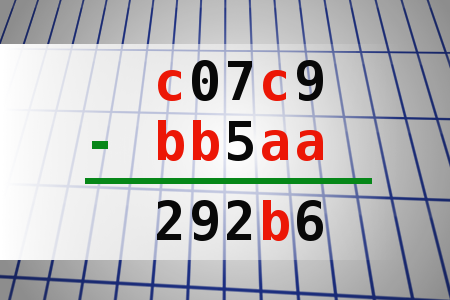
Find number abc
[5715] Find number abc - If c07c9 - bb5aa = 292b6 find number abc. Multiple solutions may exist. - #brainteasers #math - Correct Answers: 32 - The first user who solved this task is Djordje Timotijevic
BRAIN TEASERS
enter your answer and press button OK

Find number abc

If c07c9 - bb5aa = 292b6 find number abc. Multiple solutions may exist.
Correct answers: 32
The first user who solved this task is Djordje Timotijevic.
#brainteasers #math
Register with your Google Account and start collecting points.
Check your ranking on list.

Funny New Year jokes-Annual conflict

As in many homes on New Year's Day, Lesley and Mark, a happily married couple, faced the annual conflict of which was more important: the football match on television, or the New Year's lunch.
Hoping to keep the peace Mark ate lunch with the rest of the family, and even lingered for some pleasant after-lunch chat before retiring to the lounge to turn on the television.
Some minutes later, Lesley looked in to see how he was and graciously even bought a cold beer for Mark.
She smiled, kissed him on the cheek and asked what the score was.
Mark told her it was half time and that the score was still 0-0
'See?' Lesley said happily, 'You didn't miss a thing.
Jokes of the day - Daily updated jokes. New jokes every day.
Follow Brain Teasers on social networks

Brain Teasers

puzzles, riddles, mathematical problems, mastermind, cinemania...

Shapley-Curtis debate

In 1920, Harlow Shapley of the Mount Wilson Observatory and Heber D. Curtis of the Lick Observatory in California, two leading astronomers, debated each other at the Smithsonian Institution on the relationship of the Milky Way Galaxy to the Universe. Shapley's position was that the Milky Way is the only galaxy in the universe,.Curtis, however, argued that the Milky Way exists as just one of many “island universes” in the cosmos. Whereas both scientists provided a stimulating debate, it was Curtis who was vindicated for his opinion when the island universe theory was validated by Edwin Hubble, whose paper was read on 1 Jan 1925 to a meeting of the American Astronomical Society.
This site uses cookies to store information on your computer. Some are essential to help the site properly. Others give us insight into how the site is used and help us to optimize the user experience. See our privacy policy.