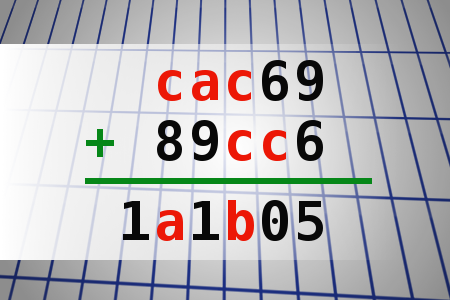
Find number abc
[5971] Find number abc - If cac69 + 89cc6 = 1a1b05 find number abc. Multiple solutions may exist. - #brainteasers #math - Correct Answers: 29 - The first user who solved this task is Nasrin 24 T
BRAIN TEASERS
enter your answer and press button OK

Find number abc

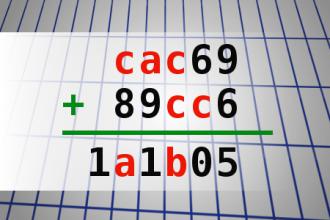
If cac69 + 89cc6 = 1a1b05 find number abc. Multiple solutions may exist.
Correct answers: 29
The first user who solved this task is Nasrin 24 T.
#brainteasers #math
Register with your Google Account and start collecting points.
Check your ranking on list.

Big People Words

A group of kindergartners were trying to become accustomed to the first grade. The biggest hurdle they faced was that the teacher insisted on no baby talk.
"You need to use 'big people' words," she'd always remind them. She asked Chris what he had done over the weekend. "I went to visit my Nana."
"No, you went to visit your GRANDMOTHER. Use big people words!" She then asked Mitchell what he had done. "I took a ride on a choo-choo."
She said, "No, you took a ride on a TRAIN. Use big people words." She then asked Bobby what he had done. "I read a book," he replied.

"That's WONDERFUL!" the teacher said. "What book did you read?" Bobby thought about it, then puffed out his little chest with great pride and said, "Winnie the Shit."

Jokes of the day - Daily updated jokes. New jokes every day.
Follow Brain Teasers on social networks

Brain Teasers

puzzles, riddles, mathematical problems, mastermind, cinemania...

Hooke member of Royal Society

In 1663, Robert Hooke was one of 98 persons who were declared members at a meeting of the Royal Society. He was admitted to society on 3 Jun 1663, and was peculiarly exempted of all payments. Before the Royal Society had been establish in 1660, Hooke was already distinguished for the invention of various astronomical instruments, and the air-pump he contrived for Charles Boyle (whom he had assisted for several years with chemical experiments at the Philosophical Society, Oxford). He invented a balance or pendulum spring (1656-58), one of the greatest improvements in the construction of timepieces. By 1662, he had been appointed curator of experiments to the Royal Society, and on 11 Jan 1664, awarded a salary of £30 per annum for life for that position.«
This site uses cookies to store information on your computer. Some are essential to help the site properly. Others give us insight into how the site is used and help us to optimize the user experience. See our privacy policy.