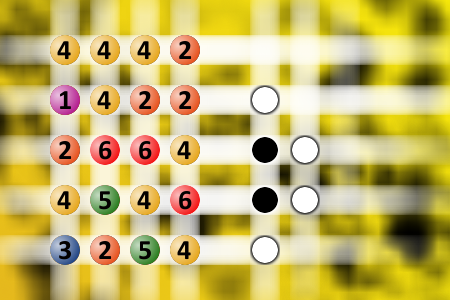
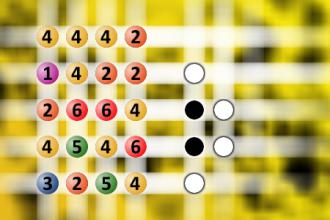
Find the right combination
[5970] Find the right combination - The computer chose a secret code (sequence of 4 digits from 1 to 6). Your goal is to find that code. Black circles indicate the number of hits on the right spot. White circles indicate the number of hits on the wrong spot. - #brainteasers #mastermind - Correct Answers: 29 - The first user who solved this task is Nasrin 24 T
BRAIN TEASERS
enter your answer and press button OK

Find the right combination

The computer chose a secret code (sequence of 4 digits from 1 to 6). Your goal is to find that code. Black circles indicate the number of hits on the right spot. White circles indicate the number of hits on the wrong spot.
Correct answers: 29
The first user who solved this task is Nasrin 24 T.
#brainteasers #mastermind
Register with your Google Account and start collecting points.
Check your ranking on list.

International Bat Appreciation Day Joke

Today is International Bat Appreciation Day! Find a joke about it!

What is a bats favorite TV show?
Love at first bite.

What does a vampire use to bake cakes?
Batter.

What’s printed in the newspapers when a vampire dies?
An obatuary.

What did the bat do when he didn’t know the answer to the teacher‘s question?
He winged it.

How does a bat say hi to her mum?
With a sound wave.

Why do bats live in caves?
Because they rock.

What’s a vampire bat’s favorite fruit?
A neck-tarine.

How do bats do the register at school?
In alpha-bat-ical order.

What animals are best at cricket?
Bats.

What do little bats eat?
Alpha-bat soup.

#internationalbatappreciationday

Jokes of the day - Daily updated jokes. New jokes every day.
Follow Brain Teasers on social networks

Brain Teasers

puzzles, riddles, mathematical problems, mastermind, cinemania...

Charles Townes

Born 28 Jul 1915; died 27 Jan 2015 at age 99. Charles Hard Townes was an American physicist who shared (with the Soviet physicists Aleksandr M. Prokhorov and Nikolay G. Basov) the 1964 Nobel Prize for Physics “for fundamental work in the field of quantum electronics, which has led to the construction of oscillators and amplifiers based on the maser-laser principle.” He had been applying microwave physics to study the interactions between microwaves and molecules, producing microwave spectra, which he thought could be used to determine the structure of molecules, atoms and nuclei. Instead, from this work, in 1951, he conceived the idea of the maser andpursued that goal. By early 1954, using ammonia gas as the medium, the first results of amplification and generation of electromagnetic waves by stimulated emission were obtained. They coined the word maser for this device, an acronym using the initial letters of “Microwave Amplification by Stimulated Emission of Radiation.”«
This site uses cookies to store information on your computer. Some are essential to help the site properly. Others give us insight into how the site is used and help us to optimize the user experience. See our privacy policy.