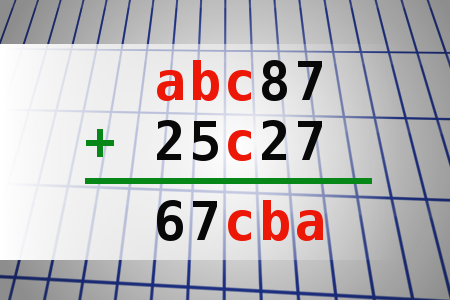
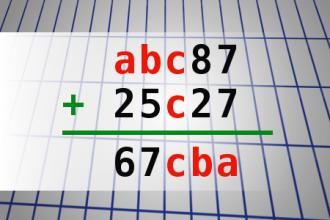
Find number abc
[6106] Find number abc - If abc87 + 25c27 = 67cba find number abc. Multiple solutions may exist. - #brainteasers #math - Correct Answers: 27 - The first user who solved this task is Nasrin 24 T
BRAIN TEASERS
enter your answer and press button OK

Find number abc

If abc87 + 25c27 = 67cba find number abc. Multiple solutions may exist.
Correct answers: 27
The first user who solved this task is Nasrin 24 T.
#brainteasers #math
Register with your Google Account and start collecting points.
Check your ranking on list.

A very shy guy goes into a bar...

A very shy guy goes into a bar and sees a beautiful woman sitting at thebar. After an hour of gathering up his courage he finally goes over to herand asks, tentatively, "Um, would you mind if I chatted with you for awhile?"
She responds by yelling, at the top of her lungs, "No, I won't sleep withyou tonight!" Everyone in the bar is now staring at them.
Naturally, the guy is hopelessly and completely embarrassed and he slinksback to his table.
After a few minutes, the woman walks over to him and apologizes. Shesmiles at him and says, "I'm sorry if I embarrassed you. You see, I'm agraduate student in psychology and I'm studying how people respond toembarrassing situations."
To which he responds, at the top of his lungs, "What do you mean $200?"
Jokes of the day - Daily updated jokes. New jokes every day.
Follow Brain Teasers on social networks

Brain Teasers

puzzles, riddles, mathematical problems, mastermind, cinemania...

Gerard Henri de Vaucouleurs

Died 7 Oct 1995 at age 77 (born 25 Apr 1918).French-born U.S. astronomer whose pioneering studies of distant galaxies contributed to knowledge of the age and large-scale structure of the universe. He produced three Reference Catalogues of bright galaxies (1964, 1976, 1991). Each was a homogenization of data from widely different sources, so that the catalogues would not be merely finding lists or data collection lists, but astrophysically useful databases. Using data in the Reference Catalogues, he was able to develop new distance indicators and refine others. His unique philosophy on distance matters was "spreading the risks," that is, applying as many different and independent techniques as possible to check for scale and zero-point errors.
This site uses cookies to store information on your computer. Some are essential to help the site properly. Others give us insight into how the site is used and help us to optimize the user experience. See our privacy policy.