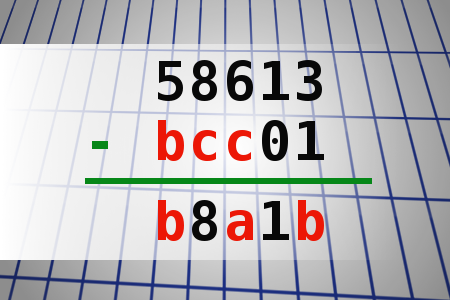
Find number abc
[6906] Find number abc - If 58613 - bcc01 = b8a1b find number abc. Multiple solutions may exist. - #brainteasers #math - Correct Answers: 17 - The first user who solved this task is Nasrin 24 T
BRAIN TEASERS
enter your answer and press button OK

Find number abc

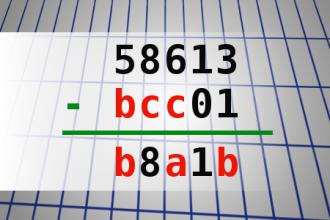
If 58613 - bcc01 = b8a1b find number abc. Multiple solutions may exist.
Correct answers: 17
The first user who solved this task is Nasrin 24 T.
#brainteasers #math
Register with your Google Account and start collecting points.
Check your ranking on list.

Bathtub

It doesn't hurt to take a hard look at yourself from time to time, and this should help get you started.
During a visit to the mental asylum, a visitor asked the director what the criterion was that defined whether or not a patient should be institutionalized.
"Well," said the Director, "we fill up a bathtub, then we offer a teaspoon, a teacup and a bucket to the patient and ask him or her to empty the bathtub."
"Oh, I understand," said the visitor. "A normal person would use the bucket because it's bigger than the spoon or the teacup."
"No," said the Director, "A normal person would pull the plug. Do you want a room with or without a view?"

Jokes of the day - Daily updated jokes. New jokes every day.
Follow Brain Teasers on social networks

Brain Teasers

puzzles, riddles, mathematical problems, mastermind, cinemania...

Diagnostic public heath laboratory

In 1892, the New York City health department established the first diagnostic public heath laboratory in the U.S. as its Division of Pathology, Bacteriology and Disinfection. It was spurred by the scare of Asiatic cholera at the time. In 1887, Drs. Hermann M. Biggs and T. Mitchell Prudden had been able to isolate cholera vibrios from passengers on a ship of immigrants. Biggs lobbied for the establishment of a laboratory for the purpose, and was able to use this new diagnosis when he was made director of the new Division. From the testing of suspected cholera cases he initiated, he was able to make positive identification of several among them. In 1893, the laboratory expanded its work to test for diphtheria and tuberculosis.*
This site uses cookies to store information on your computer. Some are essential to help the site properly. Others give us insight into how the site is used and help us to optimize the user experience. See our privacy policy.