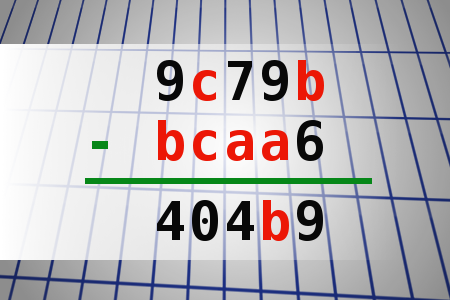
Find number abc
[7655] Find number abc - If 9c79b - bcaa6 = 404b9 find number abc. Multiple solutions may exist. - #brainteasers #math - Correct Answers: 8
BRAIN TEASERS
enter your answer and press button OK

Find number abc

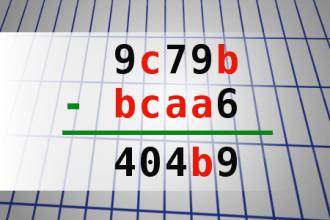
If 9c79b - bcaa6 = 404b9 find number abc. Multiple solutions may exist.
Correct answers: 8
#brainteasers #math
Register with your Google Account and start collecting points.
Check your ranking on list.

While on a road trip, an elder...

While on a road trip, an elderly couple stopped at a roadside restaurant for lunch. After finishing their meal, they left the restaurant and resumed their trip. When leaving, the elderly woman unknowingly left her glasses on the table. And, she didn't miss them until after they had been driving about twenty minutes. By then, to add to the aggravation, they had to travel quite a distance before they could find a place to turn around in order to return to the restaurant to retrieve her glasses.
All the way back, the elderly husband became the classic grouchy old man. He fussed and complained and scolded his wife relentlessly during the entire return drive. The more he chided her, the more agitated he became. He just wouldn't let up one minute.
To her relief, they finally arrived at the restaurant. And as the woman got out of the car and hurried inside to retrieve her glasses, the old geezer yelled to her, "While you're in there, you might as well get my hat".
Jokes of the day - Daily updated jokes. New jokes every day.
Follow Brain Teasers on social networks

Brain Teasers

puzzles, riddles, mathematical problems, mastermind, cinemania...

Spectrophotometer

In 1935, the first U.S. patent for a spectrophotometer was issued to Professor Arthur Cobb Hardy of Wellesley, Mass. (No. 1,987,441) which he called a “photometric apparatus.”It could detect two million different shades of colour and make a permanent record chart of the results. The patent was assigned to the General Electric Company of Schenectady, N.Y. which sold the first machine on 24 May 1935. It used a photo-electric device to receive light alternately from a sample and from a standard for comparison. It eliminated any need for the two beams (from sample and from standard) to travel different optical paths which in previous designs could introduce inaccuracies if one path varied from the other.«[Image: a "GE-Hardy" double-beam recording spectrophotometer photographed in 1938 showing Walt Disney with the instrument at his studios.]
This site uses cookies to store information on your computer. Some are essential to help the site properly. Others give us insight into how the site is used and help us to optimize the user experience. See our privacy policy.