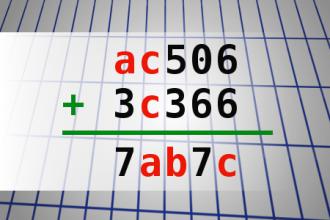
Find number abc
[7763] Find number abc - If ac506 + 3c366 = 7ab7c find number abc. Multiple solutions may exist. - #brainteasers #math - Correct Answers: 2
BRAIN TEASERS
enter your answer and press button OK

Find number abc

If ac506 + 3c366 = 7ab7c find number abc. Multiple solutions may exist.
Correct answers: 2
#brainteasers #math
Register with your Google Account and start collecting points.
Check your ranking on list.

Welfare Office

A woman went down to the Welfare Office to get aid.

The office worker asked her, "How many children do you have?"

"Ten," she replied.

"What are their names?" he asked.

"David, David, David, David, David, David, David, David, David and David," she answered.

"They're all named David?" he asked "What if you want them to come in from playing outside?"

"Oh, that's easy," she said. "I just call 'David,' and they all come running in."

"And, if you want them to come to the table for dinner?"

"I just say, 'David, come eat your dinner'," she answered.

"But what if you just want ONE of them to do something?" he asked.

"Oh, that's easy," she said. "I just use their last name!"

Jokes of the day - Daily updated jokes. New jokes every day.
Follow Brain Teasers on social networks

Brain Teasers

puzzles, riddles, mathematical problems, mastermind, cinemania...

William Whewell

Died 6 Mar 1866 at age 71 (born 24 May 1794). English scholar and philosopher known for his survey of the scientific method and for creating scientific words. He founded mathematical crystallography and developed a revision of Friedrich Mohs's classification of minerals. He created the words scientist and physicist by analogy with the word artist. They soon replaced the older term natural philosopher. Other useful words were coined to help his friends: biometry for John Lubbock; Eocine, Miocene and Pliocene for Charles Lyell; and for Michael Faraday, anode, cathode, diamagnetic, paramagnetic, and ion (whence the sundry other particle names ending -ion). In metereology, Whewell devised a self-recording anemometer. He was second only to Isaac Newton for work on tidal theory. He died as a result of being thrown from his horse.«*
This site uses cookies to store information on your computer. Some are essential to help the site properly. Others give us insight into how the site is used and help us to optimize the user experience. See our privacy policy.