
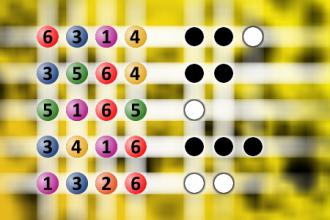
Which is a winning combination of digits?
The computer chose a secret code (sequence of 4 digits from 1 to 6). Your goal is to find that code. Black circles indicate the number of hits on the right spot. White circles indicate the number of hits on the wrong spot.
Nasty women?
Why do only 10 percent of men make it to heaven?
Because if they all went, it would be called hell.
How are husbands like lawn mowers?
They're hard to get started, they emit noxious fumes, and half the time they don't work.
How can you tell when a man is well hung?
When you can just barely slip your finger in between his neck and the noose.
How do you get a man to stop biting his nails?
Make him wear shoes.
How many men does it take to screw in a light bulb?
One. He just holds it up there and waits for the world to revolve around him.
How many men does it take to screw in a light bulb?
Three. One to screw in the bulb and two to listen to him brag about the screwing part.
How many men does it take to tile a bathroom?
Two - if you slice them very thinly.
Why can't men get mad cow disease?
Because they are pigs.
What do you call a handcuffed man?
Trustworthy.
What does it mean when a man is in your bed gasping for breath and calling your name?
You didn't hold the pillow down long enough.
How does a man show he's planning for the future?
He buys an extra case of beer.
What do you call the useless piece of skin on a penis?
The man.
Why do men have a hole in their penis?
So their brains can get some oxygen now and then.
Why do men name their penises?
Because they don't like the idea of having a stranger make 90 percent of their decisions.
Why does it take 100 million sperm to fertilize an egg?
Because not one will stop and ask for directions.
What makes a man think about a dinner by candlelight?
A power failure.
What should you give a man who has everything?
A woman to show him how to work it.
What has eight arms and an IQ of 60?
Four guys watching a football game.
What's the best way to force a man to do sit?ups?
Put the remote control between his toes.
What's a man's idea of honesty in a relationship?
Telling you his real name.
What's the difference between Big Foot and intelligent man?
Big Foot has been spotted several times.
Why did God create man before woman?
He didn't want any advice.
Why did God create man before woman?
Because you need a rough draft before creating your masterpiece.
Why do doctors slap babies' bums right after they're born?
To knock the penises off the smart ones.
Why do little boys whine?
Because they're practicing to be men.