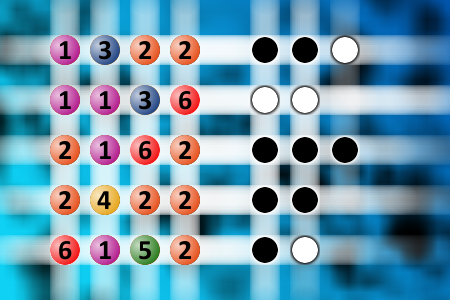
Find the right combination
[6652] Find the right combination - The computer chose a secret code (sequence of 4 digits from 1 to 6). Your goal is to find that code. Black circles indicate the number of hits on the right spot. White circles indicate the number of hits on the wrong spot. - #brainteasers #mastermind - Correct Answers: 18 - The first user who solved this task is Nasrin 24 T
BRAIN TEASERS
enter your answer and press button OK

Find the right combination

The computer chose a secret code (sequence of 4 digits from 1 to 6). Your goal is to find that code. Black circles indicate the number of hits on the right spot. White circles indicate the number of hits on the wrong spot.
Correct answers: 18
The first user who solved this task is Nasrin 24 T.
#brainteasers #mastermind
Register with your Google Account and start collecting points.
Check your ranking on list.

Little Boy in Thunder Storm

One summer evening during a violent thunderstorm a mother was tucking her small boy into bed. She was about to turn off the light when he asked with a tremor in his voice, "Mommy, will you sleep with me tonight?"

The mother smiled and gave him a reassuring hug. "I can't dear," she said. "I have to sleep in Daddy's room." A long silence was broken at last by a shaken little voice saying, "The big sissy."

Jokes of the day - Daily updated jokes. New jokes every day.
Follow Brain Teasers on social networks

Brain Teasers

puzzles, riddles, mathematical problems, mastermind, cinemania...

Philip W. Anderson

Born 13 Dec 1923. Philip Warren Anderson is an American physicist who shared (with John H. Van Vleck and Sir Nevill F. Mott)the 1977 Nobel Prize for Physics for his research on semiconductors, superconductivity, and magnetism. He made contributions to the study of solid-state physics, and research on molecular interactions has been facilitated by his work on the spectroscopy of gases. He conceived a model (known as the Anderson model) to describe what happens when an impurity atom is present in a metal. He also investigated magnetism and superconductivity, and his work is of fundamental importance for modern solid-state electronics, making possible the development of inexpensive electronic switching and memory devices in computers.
This site uses cookies to store information on your computer. Some are essential to help the site properly. Others give us insight into how the site is used and help us to optimize the user experience. See our privacy policy.