How many children are there in their family?
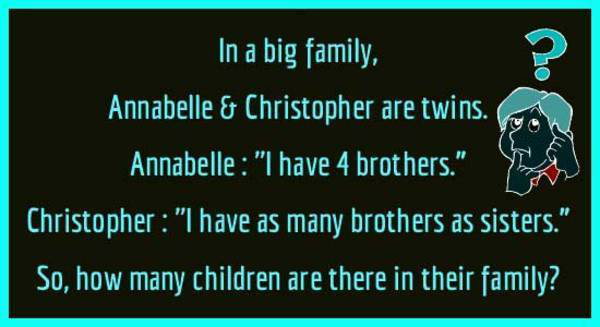
[2042] How many children are there in their family? - In a big family, Annabelle and Christopher are twins. Annabelle: ''I have 4 brothers.'' Christopher: ''I have as many brothers as sisters.'' So, how many children are there in their family? - #brainteasers #riddles - Correct Answers: 218 - The first user who solved this task is Allen Douglas
BRAIN TEASERS
enter your answer and press button OK

How many children are there in their family?

In a big family, Annabelle and Christopher are twins. Annabelle: ''I have 4 brothers.'' Christopher: ''I have as many brothers as sisters.'' So, how many children are there in their family?
Correct answers: 218
The first user who solved this task is Allen Douglas.
#brainteasers #riddles
Register with your Google Account and start collecting points.
Check your ranking on list.

9-1-1, what is your emergency?

"9-1-1, what is your emergency?"

"Help! I was hunting in the woods with my friend, and he suddenly dropped dead for no reason! Oh my God, I'm freaking out!!"

"Calm down, sir, we'll get you through this. The first thing we need to do is make sure that your friend really is dead."

"All right, hold on a second."

BLAM!

"Okay, now what?"

Jokes of the day - Daily updated jokes. New jokes every day.
Follow Brain Teasers on social networks

Brain Teasers

puzzles, riddles, mathematical problems, mastermind, cinemania...

Alexander William Williamson

Born 1 May 1824; died 6 May 1904 at age 80. English chemist whose research on alcohols and ethers clarified organic molecular structure. He was the first to explain the action of a catalyst in terms of the formation of an intermediate compound. Williamson was the first to make 'mixed' ethers, with two different alkyl groups, by a method still known as the Williamson synthesis in which an alkoxide reacts with with an alkyl halide. In the early 1850's, he first noted and described reversible reactions such as those of alcohols and ethers in which products of a reaction may recombine to form the reactants). He named the "dynamic equilibrium" in the case where the rate of the forward reaction is the same as that of the reverse reaction, and all compounds in the process coexist.
This site uses cookies to store information on your computer. Some are essential to help the site properly. Others give us insight into how the site is used and help us to optimize the user experience. See our privacy policy.