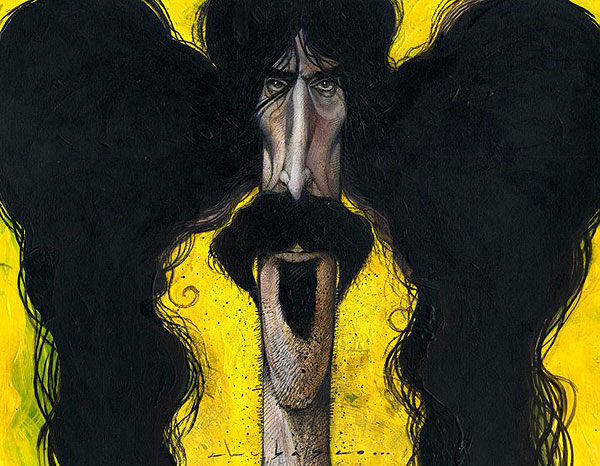
Look carefully caricature an...
[2832] Look carefully caricature an... - Look carefully caricature and guess the name of musician. - #brainteasers #music - Correct Answers: 55 - The first user who solved this task is Donya Sayah30
BRAIN TEASERS
enter your answer and press button OK

Look carefully caricature an...

Look carefully caricature and guess the name of musician.
Correct answers: 55
The first user who solved this task is Donya Sayah30.
#brainteasers #music
Register with your Google Account and start collecting points.
Check your ranking on list.

Bowling Team

Two bowling teams, one of all Blondes and one of all Brunettes, charter a double-decker bus for a weekend bowling tournament in Atlantic City. The Brunette team rides in the bottom of the bus. The Blonde team rides on the top level. The Brunette team down below is whooping it up having a great time, when one of them realises she doesn't hear anything from the Blondes upstairs.

She decides to go up and investigate. When the Brunette reaches the top, she finds all the Blondes frozen in fear, staring straight-ahead at the road, and clutching the seats in front of them with white knuckles.

She says, "What the heck's goin' on up here? We're havin' a grand time downstairs!" One of the Blondes looks up and says, "Yeah, but you've got a driver!"

Jokes of the day - Daily updated jokes. New jokes every day.
Follow Brain Teasers on social networks

Brain Teasers

puzzles, riddles, mathematical problems, mastermind, cinemania...

Johann Friedrich Blumenbach

Born 11 May 1752; died 22 Jan 1840 at age 87.German anthropologist, physiologist and comparative anatomist, frequently called the father of physical anthropology, who proposed one of the earliest classifications of the races of mankind. He divided humanity into five races: Caucasian, Ethiopian, American, Mongolian, and Malay. Blumenbach coined the term Caucasian (derived from the residents of Georgia in the Caucasus Mountains) to describe the white race; and the term Mongolian. Blumenbach was a pioneer collector of human crania and was among the first to place comparative anatomy on a completely scientific basis. His book Collectionis Suae Craniorum Diversarum Gentium Illustratae Decades (1790-1828) contains the results of his observations of the skulls of different races.
This site uses cookies to store information on your computer. Some are essential to help the site properly. Others give us insight into how the site is used and help us to optimize the user experience. See our privacy policy.