MAGIC SQUARE: Calculate A-B+C
[5063] MAGIC SQUARE: Calculate A-B+C - The aim is to place the some numbers from the list (2, 5, 7, 10, 13, 16, 34, 39, 45, 47) into the empty squares and squares marked with A, B an C. Sum of each row and column should be equal. All the numbers of the magic square must be different. Find values for A, B, and C. Solution is A-B+C. - #brainteasers #math #magicsquare - Correct Answers: 30 - The first user who solved this task is Djordje Timotijevic
BRAIN TEASERS
enter your answer and press button OK

MAGIC SQUARE: Calculate A-B+C

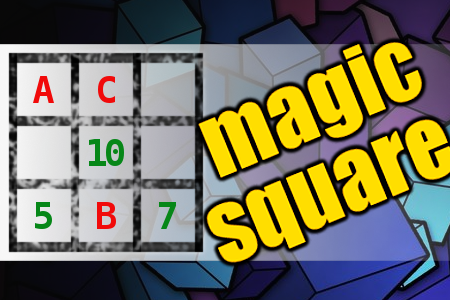
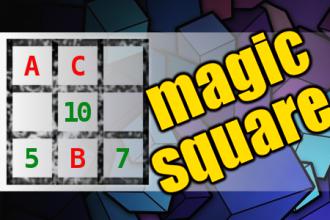
The aim is to place the some numbers from the list (2, 5, 7, 10, 13, 16, 34, 39, 45, 47) into the empty squares and squares marked with A, B an C. Sum of each row and column should be equal. All the numbers of the magic square must be different. Find values for A, B, and C. Solution is A-B+C.
Correct answers: 30
The first user who solved this task is Djordje Timotijevic.
#brainteasers #math #magicsquare
Register with your Google Account and start collecting points.
Check your ranking on list.

Hunting With A Wife

A hunter visited another hunter and was given a tour of his home. Ibn the den was a stuffed lion. The visiting hunter asked, "when did you bag him?"
The host said, "that was three years ago, when I went hunting with my wife."
"What's he stuffed with," asked the visiting hunter.
"My wife."
Jokes of the day - Daily updated jokes. New jokes every day.
Follow Brain Teasers on social networks

Brain Teasers

puzzles, riddles, mathematical problems, mastermind, cinemania...

Deuterium

In 1933, Ernest Rutherford suggested the names diplogen for the newly discovered heavy hydrogen isotope and diplon for its nucleus. He presented these ideas in the Discussion on Heavy Hydrogen at the Royal Society. For ordinary hydrogen, the lightest of the atoms, having a nuclues of a sole proton, he coined a related name: haplogen. (Greek: haploos, single; diploos, double.) In 1931, Harold Urey had discovered small quantities of atoms of heavy hydrogen wherever ordinary hydrogen occurred. The mass of its nucleus was double that of ordinary hydrogen. This hydrogen-2 is now called deuterium, as named by Urey (Greek: deuteros, second). Its nucleus, named a deuteron, has a neutron in addition to a proton.[ref: Proc. Roy. Soc. A, vol. 144 (1934)]
This site uses cookies to store information on your computer. Some are essential to help the site properly. Others give us insight into how the site is used and help us to optimize the user experience. See our privacy policy.