MAGIC SQUARE: Calculate A-B-C
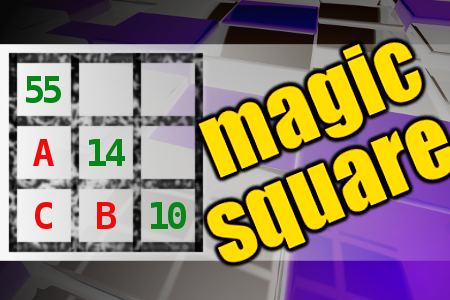
[7461] MAGIC SQUARE: Calculate A-B-C - The aim is to place the some numbers from the list (7, 10, 11, 12, 14, 16, 52, 55, 57, 71) into the empty squares and squares marked with A, B an C. Sum of each row and column should be equal. All the numbers of the magic square must be different. Find values for A, B, and C. Solution is A-B-C. - #brainteasers #math #magicsquare - Correct Answers: 1
BRAIN TEASERS
enter your answer and press button OK

MAGIC SQUARE: Calculate A-B-C

The aim is to place the some numbers from the list (7, 10, 11, 12, 14, 16, 52, 55, 57, 71) into the empty squares and squares marked with A, B an C. Sum of each row and column should be equal. All the numbers of the magic square must be different. Find values for A, B, and C. Solution is A-B-C.
Correct answers: 1
#brainteasers #math #magicsquare
Register with your Google Account and start collecting points.
Check your ranking on list.

Decisions

There are three guys in a small boat and it's sinking fast.

In the boat is a Frenchman, an American, and a Puerto Rican.

They decide that they have to throw some things overboard in order to save themselves.

"Well, I have too much of this wine and cheese," says the Frenchman, and he throws some overboard.

"Yeah, and I have too many bananas," says the Puerto Rican and he throws some overboard.

"Well, let me think," says the American, and he throws the Puerto Rican overboard.

Submitted by Curtis

Edited by Tantilazing

Jokes of the day - Daily updated jokes. New jokes every day.
Follow Brain Teasers on social networks

Brain Teasers

puzzles, riddles, mathematical problems, mastermind, cinemania...

Vincenzo Galilei

Died 2 Jul 1591 (born 1520). Italian music theorist, lutenist and composer, who as the father of Galileo Galilei, adopted experimentation to prove aspects of acoustics, and may thus have influenced his son, Galileo, away from pure, abstract mathematics and towards making experiments and investigation. Vincenzo's discoveries in acoustics included some of the physics of vibrating strings and columns of air. In particular he was the first to show that the ratio of an interval was proportional to string lengths but varied as the square of the tension applied to the strings and as the cubes of volumes of air. He recognized the superiority of equal tempered tuning and compiled a codex of pieces illustrating the use of all 24 major and minor keys as early as 1584.
This site uses cookies to store information on your computer. Some are essential to help the site properly. Others give us insight into how the site is used and help us to optimize the user experience. See our privacy policy.