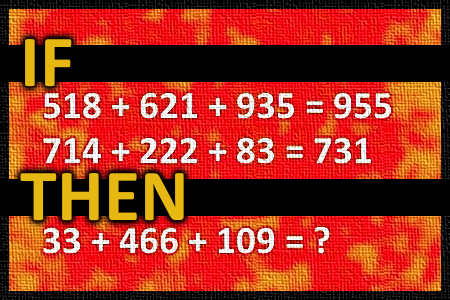
Calculate 33+466+109
[241] Calculate 33+466+109 - FUNNY MATH: Calculate 33+466+109 :) - #brainteasers #math - Correct Answers: 44 - The first user who solved this task is Slobodan Strelac
BRAIN TEASERS
enter your answer and press button OK

Calculate 33+466+109

FUNNY MATH: Calculate 33+466+109 :)
Correct answers: 44
The first user who solved this task is Slobodan Strelac.
#brainteasers #math

Register with your Google Account and start collecting points.
Check your ranking on list.

Fast Promotions

The boss called one of his employees into the office. “Rob,” he said, “you've been with the company for a year. You started off in the post
room, one week later you were promoted to a sales position, and one month after that you were promoted to district manager of the sales
department. Just four short months later, you were promoted to vice-chairman.”

“Now it's time for me to retire, and I want you to take over the company. What do you say to that?”

“Thanks,” said the employee.

“Thanks?” the boss replied. “Is that all you can say?”

“I suppose not,” the employee said. “Thanks, Dad.”

“I suppose not,” the employee said. “Thanks, Dad.”

KZ Country Cheesy Joke of the Day

Jokes of the day - Daily updated jokes. New jokes every day.
Follow Brain Teasers on social networks

Brain Teasers

puzzles, riddles, mathematical problems, mastermind, cinemania...

Sir Derek H.R. Barton

Born 8 Sep 1918; died 16 Mar 1998 at age 79. Sir Derek Harold Richard Barton was an English chemist, a joint recipient (with Norwegian Odd Hassel) of the 1969 Nobel Prize for Chemistry for research that helped establish conformational analysis (the study of the 3-D geometric structure of complex molecules). In a brief paper in Experienta entitled “The Conformation of the Steroid Nucleus” (1950), Barton showed that organic molecules in general and steroid molecules in particular could be assigned a preferred conformation based on work of chemical physicists, in particular by Odd Hassel. Conformational analysis is useful in the elucidation of configuration, in the planning of organic synthesis, and in the analysis of reaction mechanisms. It is fundamental to a complete understanding of enzymatic processes.
This site uses cookies to store information on your computer. Some are essential to help the site properly. Others give us insight into how the site is used and help us to optimize the user experience. See our privacy policy.