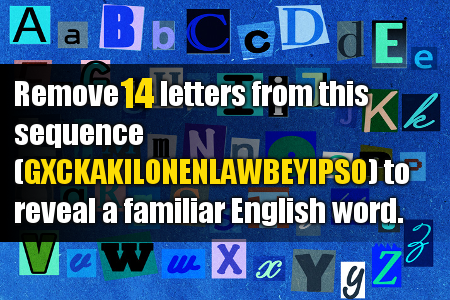
Remove 14 letters from this ...
[1750] Remove 14 letters from this ... - Remove 14 letters from this sequence (GXCKAKILONENLAWBEYIPSO) to reveal a familiar English word. - #brainteasers #wordpuzzles - Correct Answers: 28 - The first user who solved this task is Sanja Šabović
BRAIN TEASERS
enter your answer and press button OK

Remove 14 letters from this ...

Remove 14 letters from this sequence (GXCKAKILONENLAWBEYIPSO) to reveal a familiar English word.
Correct answers: 28
The first user who solved this task is Sanja Šabović.
#brainteasers #wordpuzzles
Register with your Google Account and start collecting points.
Check your ranking on list.

What happened?

"What happened?" asked the hospital visitor to the heavily bandaged man sitting up in bed.
"Well, I went down to Alton towers and decided to take a ride on the Loch Ness Monster. As we came up to the top of the highest loop, I noticed a little sign by the side of the track. I tried to read it, but it was very small and I couldn't make it out. I was so curious that I decided to go round again, but we went by so quickly that I couldn't see what the sign said.
"By now, I was determined to read that sign, so I went round a third time. As we reached the top, I stood up in the car to get a better view."
"And did you manage to see what the sign said this time?" asked the visitor.
"Yes," he said sheepishly, "Remain seated at all times!"
Jokes of the day - Daily updated jokes. New jokes every day.
Follow Brain Teasers on social networks

Brain Teasers

puzzles, riddles, mathematical problems, mastermind, cinemania...

Walter Hess

Born 17 Mar 1881; died 12 Aug 1973 at age 92.Walter Rudolf Hess was a Swiss physiologist whoshared(with António Egas Moniz) the 1949 Nobel Prize for Physiology or Medicine for “for his discovery of the functional organization of the interbrain as a coordinator of the activities of the internal organs.” In 1948, Hess devised suitable techniques to implant electrodes in the brains of rats, from which he could locate areas of the brain associated with certain instincts. Through his research, he identified how particular areas of the brain (and especially the hypothalamus) are involved with the functioning of the body's internal organs, and areas associated with autonomic functions such as sleep, hunger or defense mechanisms.«
This site uses cookies to store information on your computer. Some are essential to help the site properly. Others give us insight into how the site is used and help us to optimize the user experience. See our privacy policy.