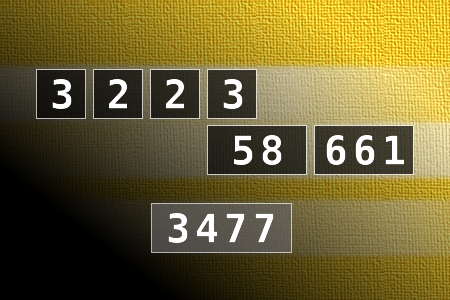
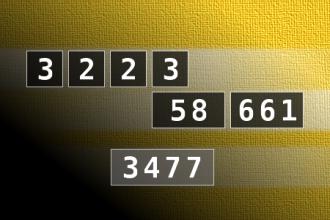
Calculate the number 3477
[1751] Calculate the number 3477 - NUMBERMANIA: Calculate the number 3477 using numbers [3, 2, 2, 3, 58, 661] and basic arithmetic operations (+, -, *, /). Each of the numbers can be used only once. - #brainteasers #math #numbermania - Correct Answers: 39 - The first user who solved this task is Sanja Šabović
BRAIN TEASERS
enter your answer and press button OK

Calculate the number 3477

NUMBERMANIA: Calculate the number 3477 using numbers [3, 2, 2, 3, 58, 661] and basic arithmetic operations (+, -, *, /). Each of the numbers can be used only once.
Correct answers: 39
The first user who solved this task is Sanja Šabović.
#brainteasers #math #numbermania
Register with your Google Account and start collecting points.
Check your ranking on list.

One evening, a man gave his ti...

One evening, a man gave his tipsy secretary a ride home after an office party. His wife was prone to jealousy, so he didn't mention the incident to her.
Later in the evening, he was driving his wife to a restaurant when he noticed a stiletto-heeled shoe half-hidden under the passenger seat. Gripped with terror, he took advantage of a moment when she wasn't looking to grab the shoe and throw it out of the window.
The rest of the journey went well until they arrived at the restaurant.
"That's strange," said his wife, looking a little agitated. "Have you seen my other shoe?"
Jokes of the day - Daily updated jokes. New jokes every day.
Follow Brain Teasers on social networks

Brain Teasers

puzzles, riddles, mathematical problems, mastermind, cinemania...

Svedberg's colloidal sol patent

In 1909, Swedish chemist Theodor Svedberg filed to patent his method of producing colloidal sols or gels, simultaneously in Great Britain, Germany, Denmark and Switzerland. By 1926, he received the Nobel Prize in Chemistry for his work with disperse systems. In colloidal systems, extremely fine particles are dispersed in a continuous medium, in which they remain suspended indefinitely. In molecular-disperse systems, the particles are large molecules like proteins or haemoglobin. Svedberg invented an ultracentrifuge to investigate them. At 40,000 revolutions/min, the particles were redistributed towards the periphery of the motion. Analysis of photographs of the distribution yielded the molecular weight of the particles.«
This site uses cookies to store information on your computer. Some are essential to help the site properly. Others give us insight into how the site is used and help us to optimize the user experience. See our privacy policy.