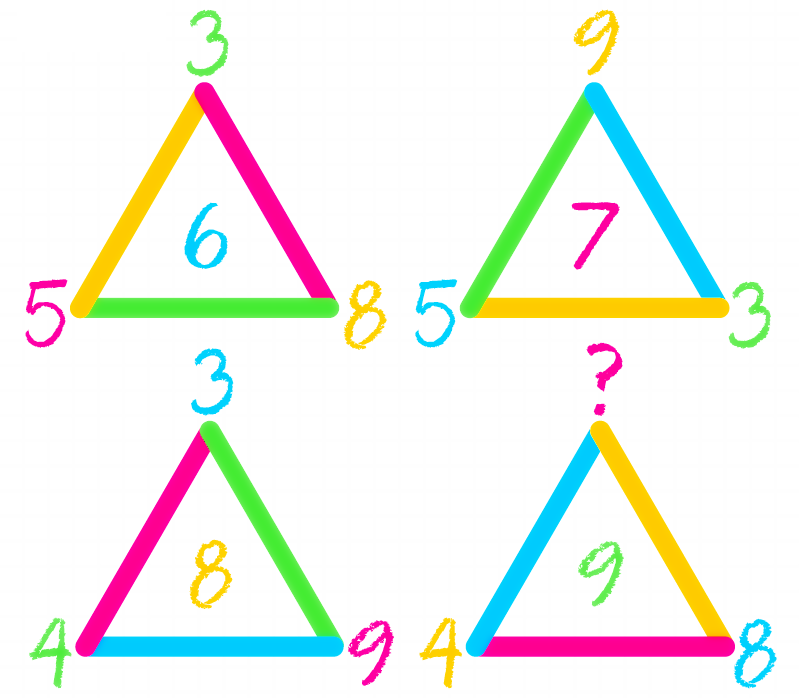
Replace the question mark with a number
[4162] Replace the question mark with a number - MATH PUZZLE: Can you replace the question mark with a number? - #brainteasers #math #riddles - Correct Answers: 104 - The first user who solved this task is Rutu Raj
BRAIN TEASERS
enter your answer and press button OK

Replace the question mark with a number

MATH PUZZLE: Can you replace the question mark with a number?
Correct answers: 104
The first user who solved this task is Rutu Raj.
#brainteasers #math #riddles
Register with your Google Account and start collecting points.
Check your ranking on list.

A Texan farmer goes to Austral...

A Texan farmer goes to Australia for a vacation.
There he meets an Aussie farmer and gets talking.
The Aussie shows off his big wheat field and the Texan says, "Oh! We have wheat fields that are at least twice as large."
Then they walk around the ranch a little, and the Aussie shows off his herd of cattle. The Texan immediately says, "We have longhorns that are at least twice as large as your cows."
The conversation has, meanwhile, almost died when the Texan sees a herd of kangaroos hopping through the field. He asks, "And what are those?"
The Aussie replies with an incredulous look, "Don't you have any grasshoppers in Texas?"
Jokes of the day - Daily updated jokes. New jokes every day.
Follow Brain Teasers on social networks

Brain Teasers

puzzles, riddles, mathematical problems, mastermind, cinemania...

Sir Arthur Keith

Died 7 Jan 1955 at age 88 (born 5 Feb 1866). Scottish anatomist and physical anthropologist who specialized in the study of fossil humans and who reconstructed early hominid forms, notably fossils from Europe and North Africa. After graduating from university (1888), he travelled as a physician on a gold mining trip to Siam. There, he dissected monkeys and became interested in racial types. In 1892, he returned to Britain and studied anatomy. In 1915, he published The Antiquity of Man, an anatomical survey of all important human fossil remains, at which time he believed that moderns humans are as old as extinct forms of humans. In 1931, New Discoveries was published in which he admitted that modern humans probably arose from types already separate in the early Pleistocene.
This site uses cookies to store information on your computer. Some are essential to help the site properly. Others give us insight into how the site is used and help us to optimize the user experience. See our privacy policy.