What a winning combination?
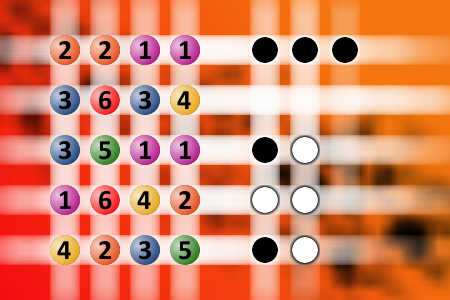
[3779] What a winning combination? - The computer chose a secret code (sequence of 4 digits from 1 to 6). Your goal is to find that code. Black circles indicate the number of hits on the right spot. White circles indicate the number of hits on the wrong spot. - #brainteasers #mastermind - Correct Answers: 62 - The first user who solved this task is On On Lunarbasil
BRAIN TEASERS
enter your answer and press button OK

What a winning combination?

The computer chose a secret code (sequence of 4 digits from 1 to 6). Your goal is to find that code. Black circles indicate the number of hits on the right spot. White circles indicate the number of hits on the wrong spot.
Correct answers: 62
The first user who solved this task is On On Lunarbasil.
#brainteasers #mastermind
Register with your Google Account and start collecting points.
Check your ranking on list.

A golfer, who was known for hi...

A golfer, who was known for his bad temper, walked into the Pro Shop one day and plunked down big bucks for a new set of woods.
The staff all watched to see what would happen after he used them for the first time - more than half expecting he'd come in and demand his money back.
But the next time he came in, he was all smiles.
"They're the best clubs I've ever had," he said. "In fact, I've discovered I can throw them at least 40 yards farther than I could my last ones."
Jokes of the day - Daily updated jokes. New jokes every day.
Follow Brain Teasers on social networks

Brain Teasers

puzzles, riddles, mathematical problems, mastermind, cinemania...

Land speed record

In 1954, to determine if a pilot could eject from an airplane at supersonic speed and live, Lt. Col. John Paul Stapp, a flight surgeon, rode a rocket sled to 632 mph. The Sonic Wind was the rocket powered sled that Stapp rode at Holloman Air Force Base, New Mexico. The sled's rocket motors generated 40,000 lbs. of thrust and he reached a speed of 632 mph in five seconds. At the end of the ride Stapp was stopped in 1.25 seconds which subjected him to 40 Gs. It was the equivalent of hitting a brick wall in a car traveling at 120 mph. Data from 29 increasingly harsh rocket-sled rides during the 1950s proved invaluable in the design of improved helmets, arm and leg restraints, better aircraft seats, and stronger safety harnesses.
This site uses cookies to store information on your computer. Some are essential to help the site properly. Others give us insight into how the site is used and help us to optimize the user experience. See our privacy policy.