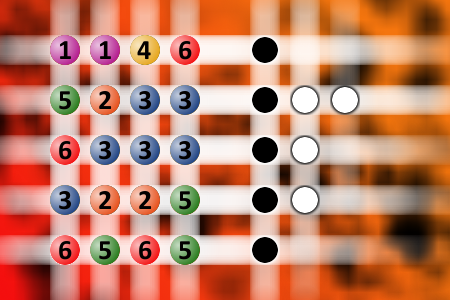
What a winning combination?
[6685] What a winning combination? - The computer chose a secret code (sequence of 4 digits from 1 to 6). Your goal is to find that code. Black circles indicate the number of hits on the right spot. White circles indicate the number of hits on the wrong spot. - #brainteasers #mastermind - Correct Answers: 20 - The first user who solved this task is Nasrin 24 T
BRAIN TEASERS
enter your answer and press button OK

What a winning combination?

The computer chose a secret code (sequence of 4 digits from 1 to 6). Your goal is to find that code. Black circles indicate the number of hits on the right spot. White circles indicate the number of hits on the wrong spot.
Correct answers: 20
The first user who solved this task is Nasrin 24 T.
#brainteasers #mastermind
Register with your Google Account and start collecting points.
Check your ranking on list.

Clocks in Heaven

A man died and arrived at the Pearly Gates. St. Peter greets him and says, "Welcome. Come walk with me and I'll show you where you'll be staying."As they're walking along the path he notices clocks on the Golden Fence of Heaven. He asks St. Peter, "What are all those clocks for?"St. Peter replies, "They’re clocks for every person in the world. They click once for each time you lie."By the time they reach where the man is staying, he asks out of curiosity, "I didn't see any politicians’ clocks. Where are they kept?"St. Peter calmly replies, "People here use them as fans."-
Jokes of the day - Daily updated jokes. New jokes every day.
Follow Brain Teasers on social networks

Brain Teasers

puzzles, riddles, mathematical problems, mastermind, cinemania...

Sir John Cockcroft

Born 27 May 1897; died 18 Sep 1967 at age 70.Sir John Douglas Cockcroft was a British physicist, who shared (with Ernest T.S. Walton of Ireland) the 1951 Nobel Prize for Physics for pioneering the use of particle accelerators to study the atomic nucleus. Together, in 1929, they built an accelerator, the Cockcroft-Walton generator, that generated large numbers of particles at lower energies - the first atom-smasher. On 14 Apr 1932, they used it to disintegrate lithium atoms by bombarding them with protons, the first artificial nuclear reaction not utilizing radioactive substances. They were first to split the atom. They conducted further research on the splitting of other atoms and established the importance of accelerators as a tool for nuclear research. Their accelerator design became one of the most useful in the world's laboratories.«
This site uses cookies to store information on your computer. Some are essential to help the site properly. Others give us insight into how the site is used and help us to optimize the user experience. See our privacy policy.