What a winning combination?
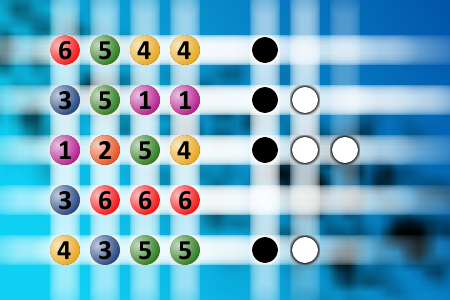
[7349] What a winning combination? - The computer chose a secret code (sequence of 4 digits from 1 to 6). Your goal is to find that code. Black circles indicate the number of hits on the right spot. White circles indicate the number of hits on the wrong spot. - #brainteasers #mastermind - Correct Answers: 6
BRAIN TEASERS
enter your answer and press button OK

What a winning combination?

The computer chose a secret code (sequence of 4 digits from 1 to 6). Your goal is to find that code. Black circles indicate the number of hits on the right spot. White circles indicate the number of hits on the wrong spot.
Correct answers: 6
#brainteasers #mastermind
Register with your Google Account and start collecting points.
Check your ranking on list.

Honey, What Did the Doctor Say?

A middle aged man goes into the doctor's office for a check-up with a litany of complaints. The doctor speaks to the man’s wife alone and says, "There is nothing the matter with your husband. If you make a couple of meals for him a day, let him watch his sports. Do not complain at him too much and require him to listen. Limit his exposure to in-laws and make love to him once a week. Then, he’ll probably live another 20 years."She returns to her husband’s side in the waiting room. He asks,
"What did the doctor tell you?"
"You are going to be dying soon, my dear."
Jokes of the day - Daily updated jokes. New jokes every day.
Follow Brain Teasers on social networks

Brain Teasers

puzzles, riddles, mathematical problems, mastermind, cinemania...

Hermann Minkowski

Died 12 Jan 1909 at age 44 (born 22 Jun 1864). German mathematician who developed the geometrical theory of numbers and who used geometrical methods to solve difficult problems in number theory, mathematical physics, and the theory of relativity. By 1907, Minkowski realised that the work of Lorentz and Einstein could be best understood in a non-euclidean space. He considered space and time, which were formerly thought to be independent, to be coupled together in a four-dimensional "space-time continuum". Minkowski worked out a four-dimensional treatment of electrodynamics. His idea of a four-dimensional space (since known as "Minkowski space"), combining the three dimensions of physical space with that of time, laid the mathematical foundation of Albert Einstein's general theory of relativity.
This site uses cookies to store information on your computer. Some are essential to help the site properly. Others give us insight into how the site is used and help us to optimize the user experience. See our privacy policy.