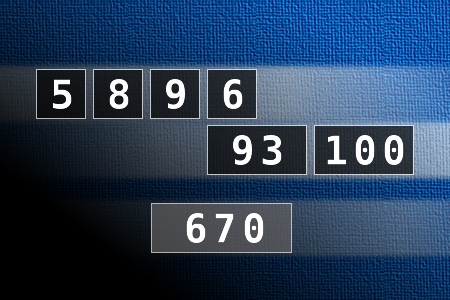
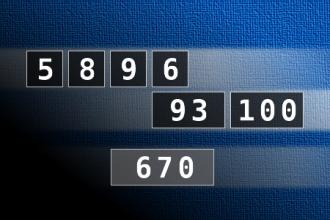
Calculate the number 670
[7348] Calculate the number 670 - NUMBERMANIA: Calculate the number 670 using numbers [5, 8, 9, 6, 93, 100] and basic arithmetic operations (+, -, *, /). Each of the numbers can be used only once. - #brainteasers #math #numbermania - Correct Answers: 2
BRAIN TEASERS
enter your answer and press button OK

Calculate the number 670

NUMBERMANIA: Calculate the number 670 using numbers [5, 8, 9, 6, 93, 100] and basic arithmetic operations (+, -, *, /). Each of the numbers can be used only once.
Correct answers: 2
#brainteasers #math #numbermania
Register with your Google Account and start collecting points.
Check your ranking on list.

Typical male

A couple was relating their vacation experiences to a friend. "It sounds as if you had a great time in Texas," the friend observed. "But didn't you tell me you were planning to visit Colorado?"

"Well," the husband said, "we changed our plans because, uh..."

His wife cut in, "Oh, tell the truth, Fred!" He feel silent, and she continued,

"You know, it's just ridiculous. Fred simply will NOT ask for directions."

Jokes of the day - Daily updated jokes. New jokes every day.
Follow Brain Teasers on social networks

Brain Teasers

puzzles, riddles, mathematical problems, mastermind, cinemania...

Georg von Kleist

Died 11 Dec 1748 (born c. 1700).Ewald Georg von Kleist was a German clergyman and physicist who was dean of the Cathedral of Kamin. Kleist experimented to store electric charge efficiently, and independently discovered (1745) the Leyden jar, an early form of thecapacitor, which in a different, miniature form is now an important electronic circuit component.The first Leyden jar was a stoppered glass jar partially filled with water with a wire or nail extending through the cork into the water. While holding the jar in one hand, the jar was charged by placing the end of the wire into contact with a static electricity producer, then removed. When Kleist touched the wire with his other hand, a discharge took place, giving himself a violent shock. The device was more thoroughly investigated by Pieter van Musschenbroek (1746).
This site uses cookies to store information on your computer. Some are essential to help the site properly. Others give us insight into how the site is used and help us to optimize the user experience. See our privacy policy.