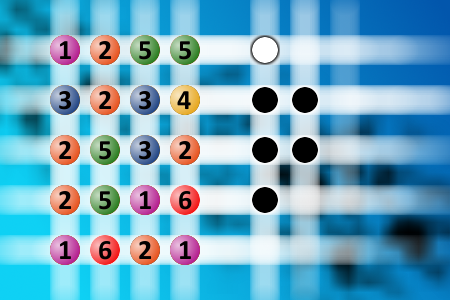
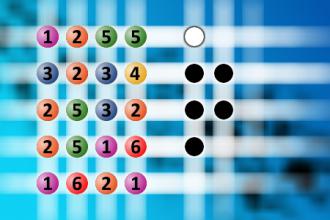
What a winning combination?
[7956] What a winning combination? - The computer chose a secret code (sequence of 4 digits from 1 to 6). Your goal is to find that code. Black circles indicate the number of hits on the right spot. White circles indicate the number of hits on the wrong spot. - #brainteasers #mastermind - Correct Answers: 2
BRAIN TEASERS
enter your answer and press button OK

What a winning combination?

The computer chose a secret code (sequence of 4 digits from 1 to 6). Your goal is to find that code. Black circles indicate the number of hits on the right spot. White circles indicate the number of hits on the wrong spot.
Correct answers: 2
#brainteasers #mastermind
Register with your Google Account and start collecting points.
Check your ranking on list.

Unexpected cold snaps had dest...

Unexpected cold snaps had destroyed the buds on a man's peach tree for two years in a row. This spring, he was ready. He replanted the sapling in a large box, mounted it on wheels, and put the tree in the garage whenever the temperature dropped.
One warm April day, the man was wheeling the tree out into the yard, and he stopped to give his dog a drink from the garden hose.
A neighbor watched the scene with amusement. "Frank," he finally commented, "you're the only man I know who walks his tree and waters his dog!"
Jokes of the day - Daily updated jokes. New jokes every day.
Follow Brain Teasers on social networks

Brain Teasers

puzzles, riddles, mathematical problems, mastermind, cinemania...

C. G. Seligman

Born 24 Dec 1873; died 19 Sep 1940 at age 66.C(harles) G(abriel) Seligman was a pioneer in British anthropology who conducted significant field research in Melanesia, Ceylon (now Sri Lanka), and, most importantly, the Nilotic Sudan. After his education as a physician he went with the Cambridge Anthropological Expedition to the Torres Straits (1898-9). Subsequently, his interests turned from medical research towards anthropology, and revisited New Guinea (1904) to distinguish the characteristic racial, cultural, and social traits of the peoples of the region. In the 1920's, he pioneered a psychoanalytic approach: studying cross-cultural similarity of dreams. He concluded that the psychology of the unconscious could provide an approach to some basic anthropological problems.
This site uses cookies to store information on your computer. Some are essential to help the site properly. Others give us insight into how the site is used and help us to optimize the user experience. See our privacy policy.