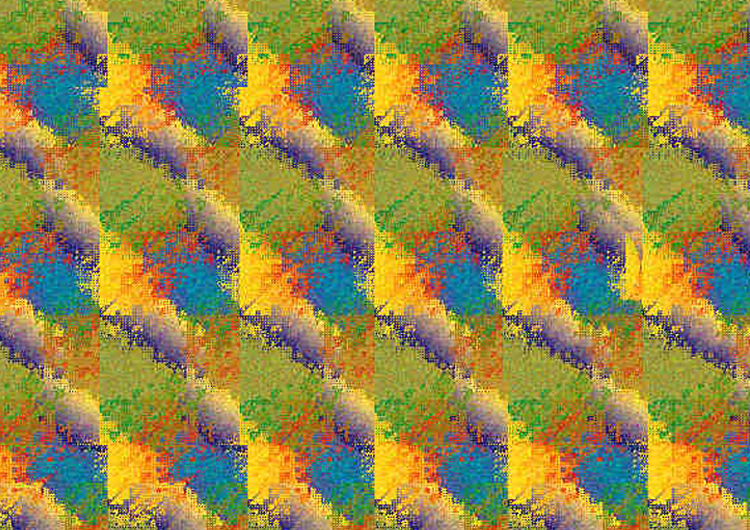
What hides this stereogram?
[1914] What hides this stereogram? - Stereogram - 3D Image - #brainteasers #stereogram #3Dimage
BRAIN TEASERS

What hides this stereogram?

Stereogram - 3D Image
#brainteasers #stereogram #3Dimage
Register with your Google Account and start collecting points.
Check your ranking on list.

President Obama and David Cameron...

President Obama and David Cameron are shown a time machine which can see 100 years into the future. They both decide to test it by asking a question each.
President Obama goes first: "What will the USA be like in 100 years time?"
The machine whirrs and beeps and goes into action and gives him a printout. He reads it out: "The country is in good hands under the new president, crime is non-existent, there is no conflict, the economy is healthy. There are no worries."
David Cameron thinks, "It's not bad time machine, I'll have a bit of that." So he asks: "What will Britain be like in 100 years time?"
The machine whirrs and beeps and goes into action, and he gets a printout.
But he just stares at it.
"Come on David," says Obama, "Tell us what it says."
"I can't! It's all in Arabic!"
Jokes of the day - Daily updated jokes. New jokes every day.
Follow Brain Teasers on social networks

Brain Teasers

puzzles, riddles, mathematical problems, mastermind, cinemania...

Antoine-Augustin Cournot

Died 31 Mar 1877 at age 75 (born 28 Aug 1801).French economist and mathematician, who was the first economist who applied mathematics to the treatment of economic questions. In 1838, he published Recherches sur les principes mathématiques de la théorie des richesses (Researches into the Mathematical Principles of the Theory of Wealth) which was a treatment of mathematical economics. In particular, he considered the supply-and-demand functions. Further, he studied the conditions for equilibrium with monopoly, duopoly and perfect competition. He included the effect of taxes, treated as changes in production costs, and discussed problems of international trade. His definition of a market is still the basis for that presently used in economics. In other work, he applied probability to legal statistics.«
This site uses cookies to store information on your computer. Some are essential to help the site properly. Others give us insight into how the site is used and help us to optimize the user experience. See our privacy policy.